• Playlist
  • Seattle Startup Toolkit
  • Portfolio
  • About
  • Job Board
  • Blog
  • Token Talk
  • News
Menu

Ascend.vc

  • Playlist
  • Seattle Startup Toolkit
  • Portfolio
  • About
  • Job Board
  • Blog
  • Token Talk
  • News

Event Recap: Valley VCs Love Seattle Startups

August 7, 2024

By: Nate Bek

Seattle's startup scene is growing, but it’s clear we have some work to do. 

That was a main takeaway from our panel discussion last week featuring venture capitalists from top-tier firms including Brentt Baltimore of Greycroft, Victoria Treyger of Felicis, and Sunil Nagaraj of Ubiquity Ventures, moderated by Kirby Winfield. Their goal: analyze Seattle's startup landscape from an outsider’s perspective with active Seattle investments. 

They see a city rich in technical talent but with several missing pieces. Go-to-market strategies often lag behind technical capabilities; capital is available, but frequently from outside the region; and stronger community cohesion is needed to bridge incumbent tech leaders with founder types. 

Here are our five favorite quotes from the panel: 

  1. Go-to-Market Strategies:"Seattle founders, in general, are not as strong in go-to-market strategies or storytelling," said Victoria. Improving these areas are key for growth.

  2. Practical Valuations: "In Seattle, you have more practical, down-to-earth people and more practical valuations," said Sunil. This approach leads to better outcomes.

  3. Community Cohesion: "There seems to be this divide between the incumbent tech community and the non-incumbent, newer people," said Brentt. Bridging this gap can strengthen the ecosystem.

  4. Founder modesty: “People are just nicer here,” said Sunil. “In the Bay Area, there's a sense of entitlement and puffing up, especially with incubators like Y Combinator cultivating a culture where being a jerk is almost expected. That doesn't happen in Seattle. Here, it's nice, nerdy people working together.”

  5. Accelerators: Seattle needs a stronger accelerator layer, similar to Y Combinator, to help founders get early customers and build effective go-to-market plans, Victoria said. 

Keep reading for the full transcript. 

*We've edited this conversation for brevity. Enjoy! — Nate 👾


Kirby Winfield: I'm Kirby Winfield, founding general partner of Ascend. We focus on pre-seed investments, primarily with Seattle founders, and specialize in AI, data, vertical software, and the horizontal AI that supports these companies. I'm thrilled to have friends from California here today.

Brentt Baltimore: I'm Brentt Baltimore from Greycroft. Thanks for having me; I'm excited to be here. I've been with Greycroft for about eight years, starting in our New York office and then moving back to LA. Greycroft is a 19-year-old firm with offices in New York and Los Angeles, and we added a San Francisco office just under a year ago. I focus on data and applied AI. Our most recent investment in Seattle is Groundlight. Our oldest investment in Seattle is Icertis, which is now much later stage.

Kirby: A little known fact about Greycroft, Dana Settle, the founding partner, I went to high school with her. She’s a Seattle local and also a University of Washington alum. 

Victoria Treyger: I'm at Felicis and have been with the firm for almost six years. We focus on seed and Series A, across all sectors. We specialize in B2B, AI infrastructure, and AI applications. I've also worked on financial software, like the office of CFO, fraud, identity, and health tech.

One unique aspect of Felicis is our global investment approach. We're based in the Bay Area, but some of our best companies, like Adyn (Netherlands), Shopify (Canada), and Canva (Australia), are from all over the world. It will be interesting to compare lessons from these ecosystems to Seattle's.

Our main Seattle investments are more recent, within the last two years. They include MotherDuck, a phenomenal company, and a cool AI infrastructure company called Predibase (co-founder Travis is based here). We also invested in Atlas Health and have a recent, yet-to-be-announced investment in Seattle.

Sunil Nagaraj: My name is Sunil Nagaraj, and I'm with Ubiquity Ventures. Ubiquity is my own small VC firm. I call it a nerdy and early venture capital firm because I love to code and focus on products and first pitches. I do about 1,000 pitches a year and have invested in about five companies here over the years.

While at Bessemer, I sourced Simply Measured and Auth-0. Under Ubiquity, I've invested in ThruWave, Esper, and Olis Robotics. I love Seattle and first got introduced to the city in 2003 when I interned at Microsoft as a PM. I fell in love with the city and visit as often as I can.

At Ubiquity, I focus on software beyond the screen. I use my current $75 million fund to write checks between $1 and $2 million for companies taking software off computers and putting it into the real, physical world. Some of my investments include software on cows, in space, in our ears, and in field devices. I tend to move quickly because I work alone. For example, with Auth-0 in 2014, it took just seven days from meeting the company to committing to their seed round, which grew into a $6 billion company in Seattle.

Kirby: So let's dive in. We'll start with a softball question to get everyone in a good mood, and then we might move on to more controversial topics. To kick off, what do you like about Seattle founders or teams? What unique qualities do you find in this ecosystem, given that you all invest in many different regions?

Brentt: What I love the most about Seattle is the amount of technical depth. Even years ago, when I first started building relationships with founders and folks operating some of the bigger companies here, I noticed this. Coming from LA and spending most of my time in data, the technical expertise here really stands out. 

As a firm, we focus on go-to-market strategies and spend most of our time supporting our portfolio companies in that area. The strong technical foundation in Seattle creates a perfect marriage for us.

Victoria: I'll add one more point, which I think is both a positive and an opportunity. Seattle founders tend to be more humble than founders in some other areas.

Kirby: Does that lead to opportunities for investors coming in the market, like pricing? Is there more value to be had here? Sometimes maybe other markets, or is that not a consideration?

Victoria: In the end, venture is a business of outliers. You're trying to find the Auth-0s and MotherDucks, the massive exits. That's really what you're looking for. Whether you're paying a 15 post or 20 post for a seed, you pick the very best founders and companies. It doesn't matter.

Sunil: I agree with everything you said. I would add that Seattle has its own strengths. I'm an emotional person, and I work alone, so I really vibe with my founders. People are just nicer here. In the Bay Area, there's a sense of entitlement and puffing up, especially with incubators like Y Combinator cultivating a culture where being a jerk is almost expected. That doesn't happen in Seattle. Here, it's nice, nerdy people working together.

When I think about founders, they're super nice, down-to-earth, and genuine people. They're about getting stuff done, not about showing off or projecting an image. I love that folks here are more humble and down-to-earth.

I do think you get more reasonable valuations here. In Seattle, when you raise money, you leave more room in your valuation for bumps along the way. In the Bay Area, if you raise at a 25 pre and then 30 pre, there's not much room for error over the next 12 months. Any hiccup can lead to a down round, which is really annoying for many reasons.

In Seattle, you have more practical, down-to-earth people and more practical valuations. VCs still buy about the same percentage, around 20% at each round, but it's more like buying 20% of a $2 million round instead of a $5 million one. This leads to a more enjoyable process and can still result in outlier outcomes like we've talked about. 

Kirby: Let's explore the cultural differences between founders, keeping in mind that we're generalizing. We know there are exceptions, but for discussion's sake, let's handle this topic generally. Some founders out here might be seen as more humble. This can be viewed positively or negatively. What are some positive and negative differences between a typical founder here and those in New York or the Bay Area?

Victoria: From my perspective, Seattle founders, in general, are not as strong in go-to-market strategies or storytelling, including engaging with the press. This is a generalization, so take it with a grain of salt. Our firm has invested significantly in Australia's ecosystem and seen incredible outcomes. I have three investments there, and my partner Wesley has two, including Canva.

Australia, to be honest, has one massive company, Atlassian, which has spun out all three of my investments. Seattle has Amazon and Microsoft. The biggest difference I've noticed is that Atlassian founders are very scrappy and GTM-focused from the start. By the time we led the seed rounds, they already had early revenue and customers without significant marketing spend. They know how to gain traction in a scrappy way, which I don't see as much with Seattle founders.

Kirby: Do you think there's something about founders who spin out of recently parabolic startups that have become great companies? When the growth amplitude within the last 10 years has surged from, say, $10 million to $1 billion, are those founders closer to the early journey? Are they more likely to have those scrappy, GTM-focused characteristics than someone coming out of Apple, Google, Amazon, or Microsoft?

Brentt: I see it a bit differently. There is no shortage of technical talent willing to take the risk of starting something new. However, there seems to be a shortage of go-to-market talent willing to take that same risk and leave bigger companies. We don't see as many CROs, COOs, heads of go-to-market, or GMs from rapidly scaling companies or large corporations like Microsoft or Amazon leaving their roles as quickly as technical talent. There's a gap in risk appetite.

Kirby: I think that's been the criticism for some time. While I might be a bit self-interested or close to it, I do see this changing as we create more successful outcomes. We now have more people who have been recently involved in growing companies. Ten years ago, it was almost impossible to hire a marketer in Seattle for a startup with fewer than five people—they just kept rotating through the same ten jobs. It's gotten better, but the criticism remains valid.

Sunil: There's a massive difference between going from zero to one versus being at a large company like Amazon or Google. At a large company, you have stability, insurance, a good salary, and, importantly, distribution. For example, when Microsoft launches a new product like Teams, they can leverage their existing customer base and automatically include it in an Office 365 subscription. This built-in distribution is a huge advantage for go-to-market efforts.

In my pre-seed deep tech investing, I think a lot about the spectrum between "look what I built" versus "look who cares." Building new deep tech innovations is challenging—you need advanced expertise and careful thought. However, communicating the value to customers is different. It's not about the technical specs but about how it benefits the user, like getting someone promoted at their job. This mindset shift is crucial.

If you come from a large company, you may not have exercised the zero-to-one distribution skills needed for startups, which are very different from scaling an established product. This reflects the talent gap, where only a few executives become the go-to experts for go-to-market strategies. This issue has been noticeable in my experience, where a handful of executives rotate as the "kingmakers" of go-to-market.

Kirby: What would it take for you guys to be pounding the table in Seattle 5-10 years from now? 

Sunil: The real issues are capital and skills. These two are interconnected. Events like this can attract more people, which brings mixed feelings. More competition for us in Seattle deals, but overall, it's positive to have investors look beyond the Bay Area.

New York had a consumer vibe, but it's now more general. Seattle has strong technical and SaaS depth, which is very attractive. Most investors don't frequently visit Seattle events, even though it's an easy trip. Promoting more capital in the area is important. We have great firms in Seattle, and while more capital might bring competition, it's beneficial for the ecosystem overall.

Kirby: Nate recently did the research, and more than 90% of the venture capital in this market comes from outside Seattle. We always tell founders that while we hope they can raise funds from one of our few local series investors, these investors simply don't have the capacity to support all the founders. The numbers clearly show this.

You mentioned that most VCs don't think of this market. I always tell this story: when I was raising for my first CEO gig around 2009, I spoke to a big multi-stage investor who said, "Oh, you're from Seattle. They don't work that hard up there, do they?" Hopefully, this attitude has changed with some recent successful outcomes, but misconceptions still linger. Even recently, I've had conversations where people say they don't want to leave their current location because there's plenty of opportunities there.

What are some misconceptions that folks in California or other areas might have about this market, especially secondary markets like Seattle?

Sunil: You've already pointed out one major misconception: the number of large exits. For example, Seattle has had five exits over $10 billion, which isn't widely publicized. Another misconception is about the talent pool. Some people think, "You can start there, but eventually, you'll have to move because there won't be enough talent to scale." This is a myth as well.

If we can gather and promote data to counter these misconceptions, it would be huge. Addressing these two big objections—whether there are real exits in Seattle and if there's enough talent to scale—can significantly change perceptions about the market.

Victoria: One thing missing in Seattle is a stronger ecosystem like YC, which focuses on acceleration. Despite the criticisms of YC, they excel at helping founders get early customers, build GTM plans, and get off the ground. When I looked at some TechStars companies here, I didn't think they provided the same level of acceleration. Pioneer Square Labs feels more like an incubator.

That accelerator layer is missing here, which ties back to the go-to-market piece. Building such an accelerator would be exciting for Seattle's amazing entrepreneurs. Interestingly, there are now 160 YC founders in Seattle, all connected through a WhatsApp group. They help each other with early customers and distribution. This kind of community support is what Seattle lacks.

Brentt: I just want to add a little bit to that. I think the community element here is multifaceted. When I first started coming up here, I noticed two distinct groups: the old-school, incumbent community of founders, funders, and buyers, and a new community of folks. These groups didn't cross over much—they felt like two very distinct sets. At various dinners and events, you could sense the division when people from these different groups were at the same table. It felt strange.

Regarding capital, there's diversity in terms of stage. There are significant pre-seed and seed investors, including what you and your team are building, and other smart, value-add investors. However, the funnel thins out after that. In the acceleration stage, there doesn't seem to be the same volume of dollars willing to take risks. This funding tends to pick up at early B stages when companies are more proven, but there's not enough capital willing to invest in the critical acceleration phase. This results in either capital on the sidelines or not enough support for companies at that stage.

Kirby: I think it ties into something we wanted to discuss. When our companies hit that stage, almost all of them are raising in the Bay Area. The numbers show they have to, but it can be a challenge for founders based here who aren't working in the Bay, and who don't have investors like us on their cap table to connect them. We've done many investments, and probably 30 of them have been raised from the Bay Area because we have that network. But that isn’t available to everyone.

How would you recommend founders here, who maybe don't have that advantage, get in the flow? How can they get in the flow, whether it's participating in hackathons or having get-to-know-you coffees with investors before they need the relationship? 

Victoria: My advice would be, and this is a new positive phenomenon I see in Seattle, to be very thoughtful when you raise your pre-seed and take your angel check. Bring investors into your cap table who are deeply connected outside of this area and have strong functional or industry expertise. I see this starting to change.

There are three amazing pre-seed funds that I know about, and there are others I might not know. For example, Kirby, who is very networked. Andrew Peterson, who has a pre-seed fund and is super networked in cybersecurity. If you're a security founder, you should take a check from him because he knows all the cyber investors outside of the Bay Area.

Another example is Tim Chen at Essence, who is a fantastic infra investor and one of the best I've met. Taking money from him is beneficial because all the top Bay Area and global firms follow what Tim is doing. 

I don’t think get-to-know-you coffee chats are worth it, that’s just my take. 

Kirby: You just saved everyone $1,000… What about founders actually embedding themselves and doing their business from places like San Francisco? From my perspective, we have a team that has been there for six months. They had been wandering the desert for a year, hacking and trying to find solutions. Being in the flow down there, they've figured out what AI infra problems actually matter. They've been able to network and talk to other builders and VCs. Now, I don’t have to worry about who’s going to do their next round because they’re there and connected. So, I’ve seen it work.

Sunil: I heard you mention a founding team that was initially struggling and then moved closer to their customers. This approach is spot on. The other details about being in the right place or meeting the right people don’t matter as much. What really matters is having happy customers. If you can bootstrap or find a cost-effective way to gain happy customers, that's the key to unlocking seed capital.

When you're looking for Series A, Series C, or beyond, having happy, paying, repeat customers will help you attract investors from anywhere, whether New York or elsewhere. It's more about proving customer interest quickly.

In a pitch, I’m most interested in hearing about your product and who it’s for. I want to know if people love it, keep coming back, or if your servers are overwhelmed by demand. That’s more important than how many times we've met for coffee or how often you stay in touch. Customer traction is what truly draws my interest.

While I do invest in some cases before customer traction, like with Esper, it’s usually in areas I know really well and can anticipate customer interest. In general, my advice is to focus on your customers above all else. Don’t worry too much about staying close to investors. Listen to your customers—they are the only ones who truly matter.

Audience Q&A: What's the biggest lever, in your opinion, that will get Seattle, not to become that amazing, complete ecosystem we all want, but that will take us on that path to being the amazing startup ecosystem? 

Victoria: I'm going to go with acceleration, leadership, and more pre-seed funds. Pre-seed GPs, like Isaac sitting in the room over there, are really good at guiding founders through to the next round. This is a significant change in Seattle over the last five years. And, of course, there's Kirby. 

The expansion of these pre-seed funds is crucial. Hopefully, they are raising money from companies like Microsoft and Amazon, which can be really helpful for distribution. That's how I see improving distribution in Seattle.

Brentt: I'm going to go in a slightly different direction and talk about the alignment of the community. What I mean by that is, everything we've talked about—capital, customers, and talent—is all here. Over time, at events, you'll see folks dwindle, but those who are truly committed will stay. That’s my honest take on the alignment part of it.

There seems to be this divide between the incumbent tech community and the non-incumbent, newer people. This isn’t unique to Seattle. For example, in Detroit around 2011 and 2012, there were the smart Ann Arbor people and the new, also smart, downtown Detroit people. Companies like Duo Security had to bridge that gap. Once the alignment happened, great things started to occur.

Tags Felicis, Greycroft, Ascend, Ubiquity Ventures

Meet Vivek Ladsariya: The new PSL VC Bridging the Valley with Seattle

July 28, 2024

By: Nate Bek

For Vivek Ladsariya, building companies is a lot like cooking. 

“You eat what you make, so don't make bullshit,” he says, a mantra that has guided his career as a founder-turned-investor.

Vivek is now Managing Director at Pioneer Square Labs and GP at PSL Ventures. In the role, he helps invest out of its $100 million fund focused on Pacific Northwest tech startups. He also works with PSL’s startup studio to create new companies. Vivek covers AI, cybersecurity, infrastructure, industrial tech, and devops. 

“Don't get too caught up in trying to bullshit your way around building a company,” he tells Ascend. Instead, founders should solve real problems, he says. 

Before joining PSL, Vivek was a GP at San Francisco–based SineWave Ventures. Throughout his career, Vivek has invested in companies like Databricks and MindMeld (acq. Cisco). He also founded and exited his own companies: GameGarage and Moyyer Secondary Markets. Vivek was featured in Forbes’ 30 under 30 section in 2018.

Founded in 2015, PSL has raised $180 million to date for its venture fund, and about $50 million to support its startup studio that has spun out more than 35 companies including Boundless, Recurrent, SingleFile, and others. 

Ascend invested alongside PSL on a number of deals, including Yesler, Meetingflow, Overland AI, Recurrent, and Iteratively. 

Vivek grew up in India and did undergraduate studies at the University of Mumbai. He earned an MBA from Yale. In his off hours, he enjoys cooking with friends and being outdoors. 

Vivek was kind enough to sit down with Ascend for our VC profile series, where we showcase early-stage investors from across the US. We talked in more depth about his VC passion, PSL’s unique value add for founders, and why cooking relates to investing. Read to the end for carve-outs.

*We've edited this conversation for brevity. Enjoy! — Nate 👾

Nate: Thanks for chatting with us, Vivek. What made you decide to be a professional investor? And what led to this moment? 

Vivek: There was certainly no active decision to become an investor — it was something that happened by fluke. I was an entrepreneur. I'd started companies in my life before. And that's all I knew how to do and what to do. I found myself after an exit without my next company lined up, and was exploring what to do, started to make a couple of angel investments and fell into the investing world. As a result, I soon enough started to love it. Because it was a really neat way to stay engaged in the early stage ecosystem, thrive on some of that early stage startup energy, while still being able to see a breadth and range of companies. And that, to me, was very exciting.

What’s getting you the most excited these days, whether that’s AI infrastructure or specific verticals? 

Horizontally, I've always focused on enterprise infrastructure. I started my career in big data, learning how to derive actionable insights from large amounts of data. This led me to invest in data analytics, data management, and data infrastructure. With every new computing shift, the types of infrastructure needed evolve. Some will be built by incumbents, but many new companies will emerge. That's where I focus a lot of my time.

Vertically, I'm excited about industries that haven't been very software-driven. I've spent time in agriculture and manufacturing, exploring opportunities there. These industries may not be large markets, but they offer great opportunities for vertical integration and driving deep value where software hasn't been prevalent. It's challenging because you need to understand the industry well to deliver precise solutions. People in agriculture, for example, buy technology for specific needs and are conscious of their spend.

As an investor, I find it exciting to learn in-depth about these industries. While most industries today are software-driven, the key question is whether they are leveraging the most modern technology and where such technology can be applied.

One of the reasons I got into journalism, and now VC, is what you mentioned on the vertical front of learning about industries that are foreign to me. I remember at GeekWire I wrote about a pasta company. And, yesterday, I went deep into proptech. There's just so many opportunities to find ways that software can help a specific industry and their pain points — it's a cool motivating factor.

It's funny, right? Back in 2011, Marc Andreessen wrote "Software is eating the world." I think it was probably true for at least 10 years before he wrote it. It's been 13 years since then, and it's still very true. I think it will be true for the next couple of decades.

Software is eating the world, and it's our job to find the little crevices that haven’t been chewed off yet. Switching gears, what's your pitch to founders? And why should they want you on their cap table? 

There's obviously a lot of nuance here, depending on the space, the co-founders, the history with the founder, and so on. Sometimes you’ve known a founder for 20 years, and there isn’t much of a pitch. But when that's not the case, there is a firm pitch because you're working with PSL as a firm and me individually as a partner. There are unique advantages to both.

PSL is exciting because we are both a company builder and an investor. This dual role allows us to understand the nuances of building companies. All partners on the team are deep operators. For an entrepreneur, partnering with a firm that truly understands the daily grind of building a company is invaluable. We at PSL share our learnings regularly and routinely.

As for me, I’ve built and sold companies before, and I leverage that experience to help founders. I pride myself on being the first phone call my portfolio companies make in tough times. Startups are hard, and I want to be the person they want to call, not just feel pressured to call. I work hard to be able to solve critical problems and be a great listener, supporter, and advocate through the challenging times that are inevitable in every startup journey. This was important to me when I was building companies, and I think it's crucial for founders today. Most of the founders I work with would probably say I’m their first phone call when things get tough.

It's a good value add. On the firm side, what's interesting is that you often hear about someone who has founder-operator experience. What's unique about PSL is that you guys are not just relying on experience from 20 years ago; you're actively building companies right now. You're using the latest technology, the newest back-end tools, and exploring emerging opportunities. You are actively iterating and hacking together with the founders… 

Not many founders get the luxury of meeting with investors to discuss how the investor is in real time using this particular RAG model to ingest data, or to search across enterprise data. I think that is really unique.

Why come from the Bay Area to Seattle? What drew you here? What opportunities are you seeing, and where do they lie right now?

When I first started evaluating Seattle, I saw it as a great opportunity—an underpriced one—with incredibly deep tech talent. This talent is building in spaces and infrastructure that I care about. It quickly became evident that Seattle isn't just a good opportunity; it might be the best location for certain types of technologies. While not for all startup building, for core infrastructure tech companies, Seattle is one of the best markets globally. The talent depth here is incredible, with some of the largest tech companies headquartered or having significant engineering hubs in the city. This creates a magnet for tech talent like no other place.

Despite being just an hour and a half flight away in San Francisco, I was far removed from the Seattle tech scene for years. Now, I see a real opportunity to build a bridge between San Francisco and Seattle, which can be a powerful way to innovate and create category-defining companies.

The bridge between the Bay Area and Seattle is crucial. At Ascend, we often discuss how Seattle has incredible engineering talent and birthed many of the world's biggest companies. However, it lacks growth-stage capital and some of the growth marketers, angels, or advisors found in the Bay Area. To scale a startup effectively, it's essential to build in Seattle while tapping into the capital and expertise available in hubs like San Francisco.

You nailed it. That's an important aspect—it doesn't need to be geographically isolated. The strengths of Seattle and the Bay Area can come together to form something powerful and unique. To me, that's where the real opportunity lies. 

What’s the bear case? 

To me, not being great at certain sectors isn't necessarily a bear case. Not every region needs to excel at everything. If we generally don't build world-class consumer companies, that's fine; they can be built elsewhere. We should focus on our strengths. The real risk is not leveraging those strengths to their maximum potential. This means not bringing the rest of the world along on our journey. If we build in isolation, we won't create large, impactful companies. Growth capital isn't abundant here; it's distributed across the country and the world. We need to engage these external resources sooner and more frequently.

Another risk is brand building. Even if we excel in non-consumer sectors, we need to solidify and promote our brand globally. The Bay Area is often too boastful, while Seattle tends to be too reserved. The sweet spot lies in building a highly credible and sincere brand while ensuring we publicize and take credit for our achievements.

What are you reading these days? What sources are filling you in on the latest RAG updates? 

We invest at the earliest stages, often mere weeks from a company's formation. This requires staying up-to-date well before a company's inception, which poses unique challenges. One approach for me has been being deeply involved in the open-source community. I keep track of promising open-source projects and those gaining momentum.

Additionally, I spend time reading research papers in the fields I care about. Researchers working at the cutting edge, or as one of my friends likes to say, the "jagged edge" of technology, often develop technologies that will commercialize in a year or two.

Practically, finding and meeting entrepreneurs involves engaging with universities and key team leaders at major tech companies like Microsoft, Amazon, Google. By being a thought partner and staying ingrained in the open-source community and research trends, I position myself as a natural choice for these leaders when they consider starting a company.

Fun question time! Spotify or Apple Music? What song is getting the most play? 

I am definitely a Spotify person, mostly because that's where my family plan is. I just use whatever my wife uses. A song I'm listening to a lot these days is "Let's Be Still" by The Head and the Heart. I play it every morning on my drive. It's a centering song that helps me pause before the chaos of the day. I play it every morning, but my favorite song changes pretty often.

Favorite shoe? 

I have these Fila squash shoes from 2018 that are completely in tatters and falling apart at the edges. But I wear them every morning when I work out because they feel like my Samurai shoes. Every time I step into them, I feel like I'm gearing up as a samurai. Outside of that, on an everyday basis, I just wear whatever shoes I find.

I love it. The routine is the important part… Now’s your time to shine. What’s your go-to ingredients in the kitchen and how do you make the case that cooking and investing are similar?

I love to cook, and my favorite ingredient, without contest, is garlic. I probably overuse it according to others, but I think it’s not used enough in most cooking. Garlic is a core part of my pantry at all times.

Interestingly, I see a lot of similarities between cooking and investing or company building. The quality of the ingredients is paramount. In cooking, if you start with great ingredients, you just have to avoid messing up too much to end up with a good dish. Similarly, in investing, the "ingredients" are the people. Focus on high-quality people, and you’re likely to build a successful company.

A friend of mine used to say, "You eat what you make, so don’t make bullshit." Eventually everything comes to roost. Everything gets put on a plate and you have to consume it. Don't get too caught up in trying to bullshit your way around building a company — build something real and solve a real problem. And, eventually, you’ll have something good to eat.

Tags Pioneer Square Labs, PSL Ventures, Vivek Ladsariya, Ascend

Kirby's mental model for pre-seed investing

July 11, 2024

By: Nate Bek

What makes pre-seed investing so paradoxical?

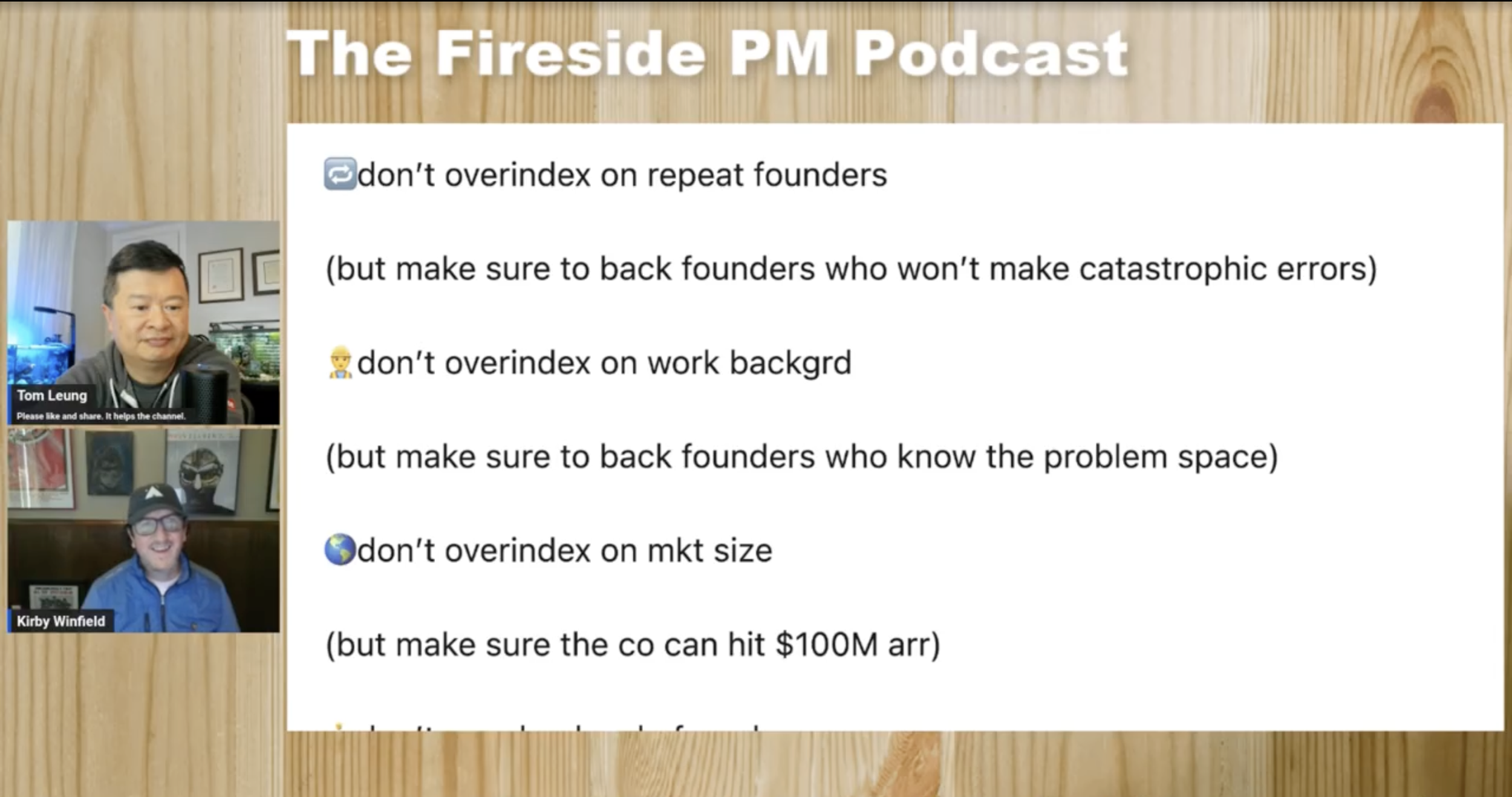
During a live Q&A session, Tom Leung, host of "The Fireside PM Podcast," posed this question to Kirby Winfield. Inspired by his LinkedIn post — which highlights several contradictions in pre-seed investing — Tom asked Kirby to methodically break down his insights, starting with, "Don’t over-index on pedigree," and, "Make sure to back PhDs."

“As an investor, I'm constantly trying to understand my mental algorithm,” Kirby says. "I started thinking, ‘I'll just use my gut. I'll know it when I see it.’ But then I unpacked my gut instincts and questioned what’s informing them… For every gut reaction you lean into, there's an equally valid instinct leaning the other way.”

Throughout the interview, Kirby untangles these paradoxes and shares his experiences, line by line.

Here are some key takeaways:

  • Gut instincts matter — Pre-seed investing is complex, but gut instincts play a crucial role. Kirby says, “You balance everything, try to figure it out, then realize, ‘Yeah, it's your gut.’” Refining these instincts helps in evaluating founders effectively.

  • Credentials aren’t everything — A Stanford PhD doesn’t guarantee success. Kirby emphasizes, “If credentials were the key, every Stanford PhD would walk out with $50 million from a VC.” Focus on a founder’s ability to find product-market fit, tell a compelling story, hire top talent, and execute their vision.

  • Upstream biases — Later-stage investors often rely on patterns and biases. Kirby says, “You have to be very thoughtful about how you navigate it.” Overcoming these biases requires backing founders who can create massive outcomes, regardless of their background.

  • Charisma vs. substance — Charisma helps in pitching but can mask deeper issues. Kirby says, “There’s a fine line between charisma and charlatanism.” Founders need more than just sales skills to succeed.

  • Revenue vs. customer love — Early success is about user love, not revenue. Kirby says, “It just matters how much the people using the product love the product.” Look for passionate customers.

  • Background vs. problem space — Founder-market fit is crucial. Direct problem experience is key, not just industry background.

  • Market size vs. ambition — Great founders can turn small markets into big opportunities. Kirby says, “The biggest misses I have are ones where I loved the founder but hated the market.” Focus on the founder’s ambition and vision.

Keep reading for the full Q&A transcript, edited for brevity and clarity.


Tom: We are back with the Fireside PM Podcast, and I have Kirby Winfield from the great city of Seattle. 

Kirby: It’s a beautiful blue sky, spring day, 60 degrees. We’re coming around that time of year where we get the rewards of having suffered through 120 days straight without sun.

You do have an amazing income tax in Washington State...

Don’t tell the legislature. Life’s still good. We still welcome a lot of our brothers and sisters from California who find their way up to our haven.

It's a trade-off, for sure. And there is no other place that is quite as beautiful as Seattle on a nice day. It's magical. Well, for those who don't know you, Kirby, why don't you just give us a little bit of an introduction, and then we can get into the meat of the conversation about pre-seed investing?

I was born and raised in Seattle. I went back east for college and graduated in 1996. After college, I moved to Manhattan to pursue a career in advertising.

Three months later, a friend called and said, "Hey, I'm starting an internet company. Come back to Seattle." So I did. I was the sixth employee at GoToNet and eventually ran marketing. We drove a third of Google's traffic and became a top 10 internet destination. We went public, and I was a 24-year-old running marketing for a $4 billion company.

That was my introduction to startups. I made every mistake in the book, but it was a forgiving time. I worked for two great co-founders, and luckily, it went well. We exited in 2000 and started another company, Marchex, where I was on the founding team. We also took it public and did a $200 million secondary offering. We bought many domain names, and I ran that business, growing it from $5 million to $50 million in just over two years.

I always say, “I mistook my good fortune for talent.” Like many, I thought, "These guys are taking companies public. I can do that." I believed I could be a CEO. I took over a venture-backed startup that raised $18 million and quickly found out it was built on questionable traffic. We pivoted to an analytics big data play, laid off two-thirds of the staff, recapitalized the company, and spent six months on Sand Hill Road shopping the deal. Two VCs were interested, but the existing VC crammed down the other. That was my introduction to venture capital. We sold the company a year later with a great outcome.

I did one more startup as a founder, raising a couple million dollars for a travel app that we sold to Expedia. Twenty years, four companies, four exits. But the ones I ran lacked the exit value of those where I just bet on the right founders.

After that last exit, I decided to switch it up and bet on founders. I did angel investing off my own balance sheet because it was at the intersection of what I liked and was good at. Most of my operating career involved tasks I didn't enjoy or excel at. As an investor, I focused on what I loved: marketing, networking, connecting people, events, and exchanging ideas. I learned from founders and offered valuable insights, having made many mistakes and had some successes.

Angel investing didn’t feel like a job. Founders appreciated my feedback, and I helped with customer introductions, hiring, and raising capital. Our mutual friend Oren Etzioni invited me to help spin out an incubator program. Eventually, LPs showed interest in a fund. I raised my first fund in 2019 and a second in 2021.

I've recently started getting into angel investing, and I definitely hear you that it is so fun talking to founders. You get a little vicarious thrill, knowing that they're on the hunt. Hopefully, I enjoy sharing some war stories and saying, "Hey, look, I know where you’re coming from. This is what I did, and some lessons I learned the hard way."

It's valuable because it’s something you can do that higher-level investors can't empathize with or share useful experiences about, beyond investment or board management. They've seen the strategy, but for the zero-to-one journey, you don't want a growth investor. You want a founder. You want someone who's been there and done that.

Well, Kirby, you did a post on LinkedIn that caught my eye. I'm going to share it on the screen here, and it has a very catchy start, which is, "Hey, pre-seed investing is easy," and then you go through a bunch of learnings. I thought it might be fun for us to go through each one and hear a little bit of the story behind it and how you arrived at that insight. The first one is, "Don't over-index on pedigree, but make sure to back PhDs." Can you say more about that?

As an investor, I'm constantly trying to understand my mental algorithm. It's like observing my own thinking process. I want to know why I’m leaning towards or away from certain founders. I map this to the data from the 80 investments we've made so far.

I started thinking, "I'll just use my gut. I'll know it when I see it." But then I unpacked my gut instincts and questioned what's informing them. What biases do I have? If you're honest and intellectually candid, you realize that for every gut instinct you lean into, there's an equally valid instinct leaning the other way. It's confounding.

It's like the midwit peak meme: the simpleton says a thing, the midwit overcomplicates it, and the genius circles back to the simpleton’s point. That's been my journey. You balance everything, try to figure it out, then realize, “Yeah, it's your gut.” This process of unpacking helps refine your mental model for evaluating founders.

You don't want to back people just because they worked at certain companies, held specific jobs, or attended prestigious universities. Outcomes are distributed more broadly than that. If credentials were the key, every Stanford PhD would walk out with $50 million from a VC. But credentials don't make someone a founder. Can they hack their way to product-market fit? Can they tell a compelling story, hire top talent, raise funds, get press, and close deals? None of this is guaranteed by a PhD.

At the same time, my job is to help founders raise funds from big venture capital firms, which often back Stanford PhDs. It might feel safer to back someone with certain credentials because they match patterns seen from later-stage investors. But that's not the right approach for pre-seed investing.

Our portfolio includes dropouts from state universities and Stanford PhDs. I think the job of investing at this stage is to curate… Investing at this stage is like being a DJ at a party. You don’t just play old-school hip-hop; you create an experience that appeals to everyone. Investing in startups requires a broad surface area, beyond any one credential set or market slice.

Let me ask you a couple of follow-up questions on the pedigree front. I’ve actually heard people take that argument even further and say, “You definitely don’t want the Stanford people, and you definitely don’t want the Google or Facebook people, because they haven’t suffered, and they don’t know how to make something out of nothing.” And if you got a Stanford PhD, you’ve been on a pretty golden path. What’s your take on that? Do you actually ding people?

It depends on who’s holding the piece of paper. If you moved here from rural India at 12, fought through the public school system, made it to college, and then leveraged that into a PhD at a great school, that's very different from someone whose parents were PhDs in California, with one running a tech company. It's about evaluating the whole person.

Some people have been at AWS for eight years because they were challenged and stimulated by the software engineering work and needed to build a nest egg. Now they want to start a company. Others have worked in machine learning at AWS for eight years and should stay there. My job is to figure out the difference between these two people who look identical on paper.

How do you do that? If they do look identical on paper, how do you tell the ones that should stay versus the ones that should go for it?

If I could bottle that, I could sell it. If I knew I had it — I just don’t know. I’ve built a Google form to score founders on different axis, but it doesn’t really matter whether I use it or not. At the end of the day, you get a feel for the person and their reasons for what they’re doing, the urgency they feel, the vision they have to build something meaningful, and their understanding of the journey. You evaluate their ability to execute on those things. That’s what matters, and that’s what we try to figure out.

Another follow-up question: you mentioned that sometimes downstream investors like that pedigree, or they put a lot of money against Stanford PhDs. Have you seen a case where you back a less conventional founder who’s producing a really legit, great growing business, and they encounter more headwinds than they should have because of that lack of resume, or do the numbers eventually speak for themselves?

It’s not companies that get parabolic growth, or they start to look a certain way from the numbers, and they have the right logos, and they’re in the right market. Those companies get funded. 

It’s more the companies that, if it were a female founder who’s been at Microsoft for 18 years and is non-technical, or a male PhD from Berkeley, both companies are doing okay. But to be venture-backable at Series A, you have to be really great. 

Historically, that’s always been the case, and then it wasn’t for a little bit, but now it is again. What does great look like? It can be that you’ve got good traction, plus a credential that takes you over the line. If you’re good but don’t have the credential that takes you over the line, or don’t have a profile that historically gets backed a lot, then you don’t clear the line. 

People will give you the benefit of the doubt more if there’s a reason to give you the benefit of the doubt. I get it. I have a freaking English major from Middlebury College; my pedigree academically isn’t going to give me the benefit of the doubt. If I’m looking at me, then there’s someone similar but with an additional set of interesting credentials that signify their intelligence and depth of knowledge and ability to focus and think critically that I don’t have… Well, I would probably invest more in that person, too. That’s data. I’m not going to say that you understand why it happens.

It sounds like if your company’s killing it, then you could not even have a college degree. It’s like, “Wow, that chart is clear. It’s parabolic. Let’s pour gas on this.” But in many cases, they are in that gray area, and that edge goes to patterns that investors are comfortable with or have seen success with in the past.

They’re comfortable, probably because they at least think they have data that shows they’ll feel good about that bet and will make their investors money. The only reason they’re doing this is to make their investors money. There’s no other reason they’re doing this. That’s what VCs do. 

The challenge exists in trying to unpack how much of that is a methodology. How much of it is PhDs making us more money because we give PhDs more money? It may be that it’s correlation, not causation, and that would be the argument. Certainly, we believe that talent is distributed equally. Opportunity isn’t. 

We’re not an impact fund, but we have folks from every kind of background as founders in our portfolio. We’re on that side of that discussion. Breaking the cycle of, we’ve done this and it works, so we should keep doing it, even if you don’t know how it would work if you didn’t do it.  

There’s no real A/B test at the growth stage. This is why it comes down to LP pressure. If institutional LPs pressure GPs to make different decisions at the growth stage, then investors at my stage are freer to do what we want. I’ve talked to female VCs at seed and Series A who know the data and see it, so they’re making investments, and they’re like, “Well, I want to back women, but 2% of venture dollars go to women. Am I going to be the one to change that, or am I just going to back a bunch of women that don’t get back to Series B and C?” It’s insidious. 

It’s not a lack of desire on the part of early-stage investors to change it. It’s a lack of incentive at the later stage to be open to it. This is not something I pound the table about, but I’m just sharing my personal views about it. It’s something most people will not talk about. My goal is to back founders, regardless of their background, who can create that parabolic company. I don’t care, even if later-stage people make decisions based on biases or bad data. I don’t think it matters because it would be irresponsible of me to invest this way if I did think it mattered. 

I’m backing people because it’s 2024, and I’m backing people who can create massive outcomes no matter who they are.

If you believe that you’re being meritocratic and completely data-driven, but you worry that later-stage investors aren’t, that creates a disincentive for you to necessarily back the best founder because you have to consider that part of being a great founder is the ability to raise capital down the line.

You have to be very thoughtful about how you navigate it. This woman, who is a Valley investor I was mentioning, she’s a stage later than me but still early. That was her conundrum. I won’t go founder by founder, but we have founders in Fund II who are from underrepresented backgrounds in venture who have Stanford PhDs. 

My approach is simple: I don’t care where you’re from, who you sleep with, or what you do in your spare time. If there's something spectacular about you that maps to the problem you're trying to solve, I want to back you. That's the way everyone should approach it. But I’m just one person.

“I think TAM (Total Addressable Market) is an excuse people use to avoid investing in founders they don’t like.”
— Kirby

Don’t over-index on charisma. What I heard from you earlier in our conversation was, “Hey, you want someone that can raise more than they maybe should and hire people that shouldn’t join them and convince customers to buy stuff that’s not quite ready.” It sounds like charisma is a really great thing to have. What do you mean by not over-indexing on it?

There’s a fine line between charisma and charlatanism. You don’t want to just back a really good salesperson. It’s very hard to invest in founders with sales backgrounds, at least for me, because they’re all really good at selling you, but there’s a lot about the job that has nothing to do with selling, and it’s the same for founders. You have to be thoughtful. 

The corollary to that is Seattle investors, when they see a Valley founder pitching them, they just want to give them money because Valley founders are so much more polished than founders in other markets because they’ve had so many more swings. They’ve worked at so many different startups. The startup culture is in the water there. They probably have five advisors who have founded companies already. You see that as an investor who doesn’t always see it and think, “Oh my gosh, this is the best founder in the world.” Well, no. No more so than they would be up here. They’re just better at pitching. 

You can’t just back people who can pitch, but it’s very hard to back people who can’t pitch, even if they’ve got other skills. 

“Don’t over-index on revenue, but make sure to back founders who can get profitable.”

At the earliest stage, it doesn’t matter whether you have $10,000 in revenue or $100,000 in revenue. It just matters how much the people using the product love the product. How sad would they be if it went away? 

I care much more about logos than revenue. Do you have five recognizable venture-backed startups as customers, and do they love what you’re giving them? That matters way more than revenue. To raise a seed round now, you need $500,000 in revenue. Two years ago, you needed a pre-seed and two co-founders. 

I’d rather have a founder who has customers and who absolutely finds their offering indispensable versus the dollar amount. What about repeat founders? “Don’t over-index on them, but make sure to back ones who won’t make catastrophic errors.”

One reason I wasn't a great founder was my cynicism and reliance on a playbook. Repeat founders can fall into that trap. The advice often is to back really young founders who don’t know what they don’t know. They'll run through walls if pointed in the right direction and eventually find the goal.

A repeat founder might move slower and have more to lose. First-time founders, especially recent college graduates, don't. Their work rate is incredible. But first-time founders sometimes run off a cliff because they weren’t looking down. They might bring on the wrong investor, hire the wrong person, or face co-founder issues.

The point is you can choose either and encounter problems with both. We back both kinds of founders.

“Don’t over-index on work background, but make sure to back founders who know the problem space?”

Just because someone was a data scientist at GitHub doesn't mean they'll automatically build a successful developer tools modern data stack technology. Product managers often want to start a company because they handle many tasks, but that's not the ideal archetype. They often lack direct responsibility.

We constantly tell founders we want founder-market fit. We want you to have a unique insight that nobody else has. The only way to have that is if you’re coming from the space where the problem exists and have worked on it directly.

There’s data supporting both sides. Yes, a successful founder might have come from WhatsApp and started a billion-dollar app analytics company. That's founder-market fit. But they could have easily been a crappy founder for other reasons. The first question is, are they going to be good at founding and growing a company? Everything else helps you feel more comfortable backing them.

It’s interesting how your post talks about these common characteristics, and for each one, there are examples and counterexamples for the rule. Ultimately, you just have to make a call. It’s not going to fit one pattern.

It's infuriating, and nobody explained this to me when I started as a venture capital investor. People often talk about luck. Many smart, hard-working people are in this job, and some get lucky while others don’t. You have to put yourself in the way of luck. You do that by getting the best deal flow, picking the best deals, and winning the deals you pick. Those are the three things that matter in venture capital. But the picking part is the hardest because of these challenges.

Market size. Some markets might be too small. I was listening to Jason Calacanis live stream, and someone pitched a marketplace for collectibles for tabletop games. I was like, wow, I don’t know how big that market is. What’s your take on how big the TAM needs to be?

I think TAM (Total Addressable Market) is an excuse people use to avoid investing in founders they don’t like. TAM is code for ambition. Amazon’s initial TAM was people who wanted to buy duck decoys. Then it was books, which was a shrinking TAM. Remember Justin.TV?

Oh, yeah.

We ran ads on that and got in trouble for it because it was pretty wild west. The thing is, with a great founder, the thing doesn’t have to be the thing. The biggest misses I have are ones where I loved the founder but hated the market. If you love the founder, find a way to like the market.

If you love the founder and hate the market, have you ever convinced the founder to look at another market, or do you just go with it?

No, because you don’t want to back the founder who will change their mind based on your feedback. So you just go. There are still deals we won’t do, like biotech. We won’t even take the meeting. There’s a marketplace-adjacent deal I’m looking at now, and we don’t do marketplaces anymore. We did it for Fund I, won’t do it in Fund II, but I like the founder. There’s a difference between market size and markets you don’t like. I don’t think market size matters. I do think there are markets I’m allergic to. Travel. Ad tech. Not surprisingly, markets I’ve operated in. 

TAM is usually about ambition. If you’re not telling me why it’s going to be monstrously big eventually, your ambition is to get a small slice of a small market. Unless you’re a dynamic founder, I’m not interested.

Why did you change your mind about marketplaces?

All the easy ones have been done. They’re slow. There’s always margin compression and a leaky bucket problem. Lots of reasons.

Don’t ever back solo founders, but make sure to back singular visionaries.

People will back solo founders. Some investors won’t back solo founders because they like to have two people making decisions. I believe I’ll make better decisions by myself. Some investors don’t like that and won’t invest.

Don’t work with assholes, but make sure to back disagreeable ones.

I love this one because I look at my portfolio and the founders I work with, and I like them all. Is that a problem? There are investors who back disagreeable founders because they understand them. It’s challenging. There are very successful funds with notoriously jerk GPs. They make money for their investors. I think about it when I meet someone disagreeable. You need to be disagreeable because nobody will believe you. There’s a mythology of the disagreeable founder. Enough founders break that rule to show that it’s not an indicator of future success. Life’s too short. If you don’t like that, don’t invest in my fund. Should I make this investment because I don’t like this person?

You’d have to engage with them for years.

Right. If they’re really an asshole, they’ll eventually kill me because I don’t like them. It’s all turtles all the way down.

How do you engage with founders, and tell us more about Ascend?

We focus on AI, but we believe it’s the evolution of technology and disruptive founders creating new companies. We’ll call it AI-native SaaS. This moment in time, every 10 years or so, incumbents get big, built on old technology and philosophies, bureaucracies. They can’t strip out their core. With generative AI, you can build a new type of company from the inside. Like the shift from steam-powered to electric-powered factories, steam-powered ones will be displaced. Generative AI companies built from the inside out with Gen AI processes are more efficient. Companies built on old sectors won’t stay around forever. We believe you’ll create a new Salesforce, edtech company, Gusto, Bloomberg. That’s our thesis. We back incredible founders passionate about the future and how they’ll shape their industry. We do that primarily in Seattle. 

At what stage should founders reach out to you? How far along should they be?

I had a founder ask this yesterday. It depends on the founder. If you’re a conventionally backable founder with a ton of credibility, it’s never too early. You can’t screw that up. If you’re like I was, pretty good but not beating down doors, you want your story straight, bootstrap for a while, and remove objections. It’s not fair, but that’s how it is. 

For me, talk to me whenever you want. I want to be there as early as possible. We’re the first check into these companies. Come to me at the idea stage. We’ve done that time and again, from idea stage through Series B. We’re on the napkin, figuring out your raise with you, and even if you’re ready to partner, we’re there to say, "This go-to-market maybe doesn’t make sense," or "Have you thought about this product direction?" We don’t do it all the time, but with the right founder, we’re happy to do it. As a friend of founders, I say, be thoughtful about when you do that, depending on your marketability.

Tags Ascend, Kirby Winfield, Pre-seed

The Art of Stepping Away: Insights from Court Lorenzini, Founder of DocuSign 

June 28, 2024

By: Nate Bek

In Seattle startup lore, few names carry as much weight as Court Lorenzini. As the founding CEO of DocuSign, he changed the ways we sign documents, creating a digital signature platform that has become ubiquitous in business transactions worldwide. But Court’s journey didn’t start or end with the e-signature giant.

“I’ve had every outcome possible for a founder,” says Court, who started multiple companies after leaving DocuSign, “so I can empathize with every condition.” 

In an exclusive chat with Ascend portfolio founders, Court shared lessons from his decades as a founder, exec, and active investor. The session offered a rare glimpse into the mind of a serial entrepreneur.

Court’s journey began in California, where he grew up in an entrepreneurial family. His father, one of the eight people credited with founding Silicon Valley, instilled in him a passion for innovation and risk-taking. After studying engineering at Duke University, Court cut his teeth at Cisco during its hyper-growth years in the 1990s. “I learned a hell of a lot from that,” he says.

But the entrepreneurial bug bit hard, and in 1996, Court left Cisco to start his first company in Seattle. Since then, he's founded four companies, including DocuSign, and has become a prolific angel investor and advisor. Today, he’s focused on helping the next generation of founders navigate startup life.

Court was a recent guest at Ascend's AMA, a monthly session for portfolio founders where experts share insights on relevant topics. He offered perspectives on team building, company culture, business models, fundraising, and the art of knowing when to step aside. Here are the main takeaways from that conversation. 

Team Building: Understanding Superpowers

Team composition is a critical factor in determining a startup’s success. Court introduces the concept of “superpowers” — unique strengths that individuals bring to a team, which go beyond skills to capture innate talents that make people exceptionally effective in specific roles.

Reflecting on his early entrepreneurial lessons, Court says, “The most important takeaway was about team development — who to hire, who to partner with, and who the right co-founders were.”

Key points about superpowers:

  • They are innate strengths, not just acquired skills.

  • Most individuals struggle to accurately identify their own superpower.

  • Understanding superpowers is essential for forming complementary teams and assigning optimal roles.

Court says he developed a specialized questionnaire for hiring, designed to help individuals discover and articulate their superpowers. This tool serves multiple purposes:

  • Identifying the most suitable role for an individual within a company;

  • forming teams with complementary strengths;

  • And guiding founders in understanding their own strengths and limitations.

“The dominant reason for failure often traces back to the founding team — who they were, what roles they assigned each other, what skills and strengths they brought to the table, where they were complementary, and where they were in conflict or duplicative.”

Culture as a Core Product

Another key insight Court shared is the importance of intentionally developing company culture.

“I now openly describe culture as a core product of the company,” he says. “If you’re spending a ton of time building your product or service, you should be spending at least as much time thinking about and strategically implementing your culture.” 

Court's approach to culture includes:

  • Elevating culture to equal importance with the company's primary product or service.

  • Proactively shaping culture rather than allowing it to evolve haphazardly.

  • Recognizing that a strong culture is crucial for retaining valuable employees.

While Court believes culture should be rooted in trust and respect, he acknowledges that successful cultures can vary based on founders' personalities and company needs.

Key elements of building a strong culture include:

  • Defining how people should treat each other within the organization.

  • Establishing guidelines for customer interactions.

  • Shaping the company's brand image in the marketplace.

  • Determining which values and causes the company supports or opposes.

Additional resources for culture development:

  • FounderNexus: A community launched by Court to help entrepreneurs build teams, get advice on current challenges, and learn from successful peers.

  • “The Culture Code,” by Daniel Coyle and “The Speed of Trust,” by Stephen Covey. 

  • Patrick Thompson’s framework: Designed to maintain a healthy office culture in remote-friendly environments. “We designed our rituals to create a shared understanding, promote psychological safety, foster personal & collective growth, and have fun!”

The Freemium Debate: Why Court Says No

Court took a bold stance against freemium models. This is unusual, especially at the time he was building DocuSign, as many startups were giving away services for free.

“I never gave anything away for free, ever,” Court says.

His arguments against freemium:

  • Pricing validates product value.

  • Unwillingness to pay may signal an ineffective solution.

  • Free users rarely convert, leading to high burn rates without revenue to show for it.

Court uses the example of EchoSign (later acq. by Adobe) to illustrate his point. While EchoSign initially gained more users through its freemium model, it struggled to monetize effectively. Meanwhile, DocuSign's paid-only approach led to sustainable growth and a multi-billion dollar valuation.

“Pricing in the model is one of your most important tools,” Court says. “It's also one of the most important ways you can vocalize and validate how you are valued in this problem stack you're trying to solve. If someone is unwilling to pay you, it might not be worth doing in the first place.”

Fundraising: A Means, Not an End

Court challenges the common startup mindset about fundraising. His perspective shifts focus from raising capital to achieving business objectives.

Key insights on fundraising:

  • Raise the minimum necessary to hit specific milestones.

  • Prioritize execution over the amount raised.

  • Remember: company success is the goal, not securing funds.

“The goal isn’t to raise money,” he adds. “The goal is to take as little as possible to get where you're going — you still need to get to where you're going.”

This approach encourages startups to:

  • Be strategic about when and how much to raise.

  • Focus on effective use of funds rather than impressive funding rounds.

  • Maintain a clear vision of business objectives beyond fundraising.

By reframing fundraising as a tool rather than a goal, Court promotes a more sustainable and focused approach to startup growth. This perspective can help founders maintain control, reduce dilution, and stay aligned with their core business objectives.

The Art of Letting Go: Knowing When to Step Aside

Perhaps one of Court’s most bold yet insightful pieces of advice is knowing when to step aside as a founder. He argues that many entrepreneurs become too emotionally attached to their companies, potentially stunting personal growth.

“I see that all the time,” Court says. “The founder gets far too emotionally connected and cannot remove themselves from the situation. It causes problems for them. It potentially causes problems for the company, depending on their style of leadership and the stage of the venture.”

Court’s philosophy on founder transitions includes:

  • Understanding that different company stages require different leadership skills.

  • Recognizing one's own strengths and limitations as a leader.

  • Being willing to bring in new leadership when the company's needs outgrow the founder's skillset.

He divides a company's lifecycle into three stages:

  • Stage I: Napkin to product-market fit. 

  • Stage II: Product-market fit through high growth. 

  • Stage III: Growth through profitability. 

Court says he’s most suited for the first stage, where he believes aligns most with his personal superpower. He suggests that the best leaders know not just how to lead, but when to change or relinquish leadership for the company's benefit. Court left DocuSign 16 years ago, just five years after the company launched. He decided the mission to scale the company at that point would be better left to another leader.

“If there’s a person that could do that job better, let them do it,” he says. “Your job is to make sure that the company reaches its highest potential.” 

Court also offers a compelling data reason for founders to consider leaving their startups: “By the time you have reached your fifth year, you have achieved between 75 and 80% of your terminal value.”

He continues, “After year five, you could stay another 20 years at that company. And you might only accrue another 20 to 25% value.”

Court's advice is to diversify your risk. Start a new company after reaching this equity milestone. This strategy maximizes potential returns while spreading risk across multiple ventures.

Tags Ascend, AMA, Court Lorenzini, DocuSign

VC for the rest of us: The ultimate guide to investing in venture capital funds for tech employees

June 12, 2024

By: Nate Bek & Sean Sternbach

For tech workers, being an early-stage startup investor holds a distinct allure. 

It’s like having a backstage pass to the pitch decks and demos that could become the next Uber, SpaceX, or OpenAI. But accessing venture capital (VC) as an asset class can seem daunting and complex — especially if you are balancing the demands of a full-time job.

Let’s break down the process.

Investors in VC funds, known as limited partners (LPs), are like the silent backers in the wings. They provide the necessary capital with limited liability, remaining largely uninvolved in the daily operations. Most LPs do not participate in scouting or decision-making, though there are a few exceptions.

Prior to recent changes, becoming a solo LP required substantial financial means. You needed an annual income of more than $200,000, or $300,000 with a spouse, or a net worth over $1 million, excluding your home.

Watch our expert LP Panel Passcode: =+0CtQyj

Recent US law changes have broadened participation. The Equal Opportunity for All Investors Act of 2023, passed by the House, lets individuals qualify as accredited investors based on financial knowledge, not just income or net worth. SEC amendments in 2020 had already included certain professional certifications.

Now, passing a FINRA exam may also qualify you.

For finance or STEM workers, these changes are major. Their expertise in tech and investment means they may meet the new criteria. This opens the door to invest in startups and private offerings previously out of reach.

We want to break down the asset class for these folks. Ascend teamed up with Cloud Capital and talked to more than a dozen LPs, legal experts, and VCs.

We combined these convos with our own insights to share a detailed FAQ.

  • The main draw is, of course, the potential for financial return. VC offers investors the chance to earn significant multiples on their principal investment throughout a typical 10-year fund cycle. A good fund might 10X your money.

    Indeed, it’s not just about the cash. VC investing also supports broader economic growth. It’s all about placing bets on the future, funding visionary founders setting out to disrupt industries from healthcare to clean energy.

    There’s also more to being an LP than financial rewards and innovation, especially in a smaller fund or angel network. Additional benefits might include:

    • Board participation: Some LPs have the chance to serve on the boards of companies within the portfolio. This role comes with governance responsibilities, strategic input, and sometimes additional equity stakes.

    • Insider knowledge: LPs get insights into the strategies and performance of startups within the fund. They use this information to offer targeted advice based on their expertise.

    • Networking opportunities: Regular interactions with fund managers and other LPs can open up further valuable investment opportunities and insights.

    It’s worth highlighting these additional reasons to consider an investment in VC and — within each reason — you should consider the following questions:

    Diversification to your financial structure

    • Does the inclusion of alternatives improve the risk/return characteristics of a portfolio?

    • Is there low correlation with public markets, or is it just an illusion of data?

    • Are suitable vehicles available to implement a diversified alternatives portfolio over time, industry, asset type and managers?

    Performance

    • Do alternatives outperform public markets?

    • How about after fees and taxes?

    • Do prior winners repeat or persist? Can we use a track record to pick winners?

    Investor Purpose

    • Are venture-based impact investments useful for advancing social objectives?

    • Are alternatives effective assets for wealth transfer?

    Business Value

    • Are alternatives the best way to “beat the market” for returns-focused clients?

    • Will alternatives help you move upmarket, or will “demystifying alternatives” be an equally effective tool set?

    • Do alternatives offer sufficient confidence and value to justify the operational complexity of delivery?

  • These days, most of the value creation gets done in the private markets. Before, it was mainly captured post-IPO.

    For instance, Amazon’s valuation in 1997 at IPO had a market cap under $1 billion. Microsoft’s market cap was also under $1 billion in 1986, when it went public.

    Today, all the larger tech companies of the decade accrue 100% of the first $20 billion in market cap pre-IPO in the privates. This means that if the right VC funds can pick great startups, there is significant upside potential before the company even goes public.

    Click here to view the graph.

    There’s been a rush into VC chasing these high returns. Here are the numbers:

    $30 trillion. That’s the amount of wealth that’ll transfer to millennials and GenX over the next several decades. This cohort of investors favor investments in private technology, evidenced by growth of platforms such as AngelList ($16 billion AUM).

    12%. That’s the average amount of allocation family offices put towards VC.

    90%. Almost universally, family offices have exposure to private equity, investing through both funds and direct transactions. VC continues to be top of mind, with up to 90% of family offices globally reporting VC investments.

  • Let’s look at VC fund performance compared to public markets.

    We evaluate this through a ratio called “Public Market Equivalent (PME).” This metric compares the cumulative return of a private equity investment (net of fees) to an investment in a public benchmark. A PME of 1.21 implies that, at the end of the fund’s life, investors ended up with 21% more than if they had invested in public markets.

    Click here to view the infographic.

    This infographic shows us that VC fund performance has outperformed each of the indices above over the time period in question. While this data is not recent, it does highlight the impact VC calls have on a portfolio.

    That said, one should still consider the following factors:

    • Risk adjustment: In general, early-stage VC tends to invest in very small companies with fat-tailed outcomes. There are a large number of failures and a few big winners.

    • After tax: How would results compare after tax to a public market fund?

    • After-estate tax: In certain cases, a public market fund may never realize gains, and it can pass through a client’s estate without tax. VC funds will likely realize gains, even if QSBS is present.

    • Additional fees: Will additional fees be applied from investment vehicles such as fund of funds to enable more confident diversified investing?

    • Liquidity: Venture funds often have long lockup periods, and it can take 10 years or more to fully realize return on capital.

    Source: Harris, Jenkinson, and Kaplan, "Private equity performance: What do we know?" (2014). As displayed in the above graphic, PME ratios use a reference index as a public benchmark. Reference indices include the S&P 500 Index, Russell 3000 Index, and Russell 2000 Index. It is not possible to invest directly in an index. Index performance does not reflect the expenses associated with the management of an actual portfolio. Past performance is not indicative of future results. Indices are shown for informational and comparison purposes only – there are no private equity holdings in any of the indices shown.

  • The first hurdle to clear is knowing your status as an investor, whether that’s meeting income thresholds or having financial sophistication. VC is among the riskiest asset classes, so the SEC wants to know that you can recover if funds are lost.

    • Tier I, accredited: You’re an accredited investor if your annual earnings exceed $200,000, or $300,000 together with your spouse, for the past two years. Another way is if your net worth is more than $1 million, excluding your primary residence. Certain financial certifications can also qualify you (more on that above). Either way, this status lets you invest in VC funds that limit their investors to 99.

    *Funds that take checks from accredited investors are typically seed-stage and in the sub-$100 million range. These requirements might mean an entry price between $250,000 to $1 million for their main funds, and they might even take less for sidecar funds.

    • Tier II, qualified purchasers: This category is for those with more than $5 million set aside for investments. Funds for qualified purchasers can accept up to 2,000 investors. These funds cater to a wealthier investor base and aren’t open to accredited investors that don’t reach the financial threshold.

    *Late-stage funds, which are much larger, will require larger check sizes to reach their fundraising goals. These VC funds usually stick to this financial criteria, but they might bend the rules for portfolio founders, close friends, and top execs.

    Here’s what else you should know:

    • LP selection: VC funds can be nit-picky about their LPs. They often prefer those with strong reputations and a clean public image, as each investor impacts the fund’s branding and appeal.

    • Professional background: Funds might favor LPs with a technical background or startup experience. This can help with board seats, advisory roles, or introductions.

    • Tech: Both big and small tech companies are generally agnostic about their employees investing in VC, as long as these investments don’t compete with the company’s interests. This is particularly true for blind funds, where LPs don’t participate in investment decisions.

    • Financial sector: If you work in finance, your company might have stricter rules to avoid conflicts of interest, especially with investments that could overlap with company operations or client interests.

    • Publicly-traded companies: These companies have specific ethics codes about investing, as well as a compliance department.

    • Build your network: Access to top funds will start with who you know. Connect with VC fund managers on LinkedIn, individuals with “Limited Partner” in their bio, as well as founders who have fundraising experience. Warm intros from portfolio founders or fellow LPs can be a valuable first step into getting in front of the right fund managers.

    • Time it right: Understand when funds are looking for investors. Keep in touch with fund managers and watch market trends to know when to make your move. Most funds will kick off the fundraising process before they are fully deployed in their previous fund. For top VC funds, it’s like catching a train — you need to be at the station at the right time.

    • Match investment sizes: Know what funds expect in terms of investment amounts. Make sure you can meet these figures and have enough cash on hand in the future to be able to meet commitments when fund managers call capital (more on that below).

  • Finding the right fund manager is the most important decision you’ll make as an LP. The fund manager’s execution influences the outcome of your investments.

    • Performance history: Review the manager’s historical performance, including returns generated, success rates of past investments, and the growth trajectories of companies they've supported. Key documents to request are Limited Partnership Agreements (LPAs), Schedules of Investments (SOIs), and recent investor updates.

    • Portfolio data: Examine the portfolio for successful exits via IPOs or acquisitions, and track startups that have secured significant funding in subsequent rounds. Metrics such as Multiple on Invested Capital (MOIC), Total Value to Paid-In (TVPI), and Internal Rate of Return (IRR) are essential for assessing a portfolio's success rate.

    • Fund duration: Remember that VC funds typically operate over a 10-year cycle. Newer funds may lack historical data, which can be used for assessing long-term performance and market adaptability.

    • Philosophical match: The VC fund’s investment thesis should resonate with your personal values, whether that’s driving social change, focusing on specific geographies, or empowering underrepresented groups.

    • Sector- and stage-focus: Match the fund’s specialized industry focus or stage of business development—from startups to growth-stage companies—with your areas of interest and perceived opportunities.

    • Operational competence: Assess the manager’s ability to effectively oversee the fund’s operations, from capital allocation to risk management and exit strategies.

    • Process: Understand the fund’s process for deal sourcing, due diligence, and investment decision-making. Ask the fund manager to explain how they can access proprietary deal flow and receive allocation in competitive deals. The best funds have robust funnels to maximize visibility and move on investment decisions quickly.

      • As an example, some funds implement a shotgun-like spray-and-pray model, where they invest in dozens of companies within the same fund. Other fund managers shoot from a sniper rifle, identifying very specific companies from deep due diligence and then write larger checks within each company they select. Understanding these types of nuances may sway you from opting-in, or out, of a fund.

    • Team: Consider the breadth of the management team’s expertise and the resources they have at their disposal for portfolio support. A strong platform team can significantly support founders and maximize the outcomes of investments by offering strategic guidance, customer leads, operational support, access to upstream investors, and more.

    • Research: As a starting point, ask the VC if you can talk to a portfolio company CEO and an LP in the fund. Ensure the VC is supporting founders how they prescribed in their fund offering and ensure that LPs are receiving regular communication about the fund as promised.

  • Middle and lower quartile funds often do not justify the risk and illiquidity profile of VC.

    Click here to view the infographic.

    With close to 4,000 US VC funds, it is difficult to keep track of all fund opportunities.

    Evaluating fund manager strategies is time consuming and requires domain expertise that involves detailed track record assessment, team dynamics, competitive positioning, portfolio construction, reference calling, etc.

    VC remains an insular category and access requires deep-seated relationships, brand and reputation, and large minimum commitments

    VC funds from 2001 to 2020, which were top quartile in their prior fund, only have a 30% chance of being top quartile, or 54% chance of being above the median, in the next fund.

    Click here to view the infographic.

    Source: Harris, Robert S., Tim Jenkinson, Steven N. Kaplan, and Rüdiger Stucke, "Has persistence persisted in private equity? Evidence from buyout and venture capital funds" (2022). PME ratios use the S&P 500 Index as a public benchmark. It is not possible to invest directly in an index. Index performance does not reflect the expenses associated with the management of an actual portfolio. Past performance is not indicative of future results. Indices are used for informational and comparison purposes only. 1. Top quartile funds are determined using PME data available at the time of fundraise for the next fund.

    • Time management: Investing in a VC fund is passive. You provide the money, and the fund managers handle the rest. It requires little of your time. Angel investing is active. You have to find startups, do the research, and make the investment decisions. It demands a lot of your time and involvement.

    • Deal flow: VC funds have access to a steady stream of deals. Fund managers use their networks and resources to find the best startups. As an angel investor, you must find your own deals. You need to network, attend events, and stay active in the startup community to discover opportunities.

    • Portfolio risks: VC funds diversify your investment across many startups, spreading the risk. Angel investing typically involves fewer startups, resulting in higher risk since your investments are more concentrated, though you reap more upside on the winners.

    • Management fees: VC funds charge management fees. You pay a percentage of your investment, usually 3%, for the fund managers’ services. Also, they take a percentage of the profit called carried interest. As an angel investor, you don’t pay management fees. However, you bear the cost of your time and resources to manage your investments.

    • Direct early-stage deals

    • Co-investments

    • Emerging Managers

    • Established Managers

    • Growth Funds

    • Fund of Funds

    Starting with the top of the list above and working its way down, you will generally see it flow from higher to lower risk profiles and also higher to lower return profiles.

  • If the topics above have not yet scared you away from this asset class, there are plenty of good reasons to consider venture capital as part of your overall portfolio.

    • Capital constraints over the past two years have created more operating discipline at startups.

    • VC’s have been valuing the quality of revenue over growth at all costs.

    • Investing is moving from “shotgun weddings” between investors and founders to traditional lengthier diligence processes for investment decisions.

    • With numerous layoffs from big tech firms, more and more talent is going the path of launching startups.

    One of the biggest reasons is that valuations across fundraising stages have come way down since mid-2022. Take a look at the valuation data from Carta between Q2 2022 and Q1 2023:

    Click here to view the infographic

    Valuations have come down across the later stage. Couple favorable valuations with new tech advancements in AI and machine learning over the past 12-18 months and there becomes opportunity for venture capital funds to perform well.

  • That’s a personal choice. It’s based on your financial health and how much risk you can handle. Many experienced investors advise beginning modestly. For example, starting with about 5% of your net worth is typical as you get familiar with the field. As one investor put it, it’s better not to put all your eggs in one basket. Investing in a fund can spread out your risk. It gives you a diverse mix of startups to invest in, which lowers the risk and eases the management load compared to direct angel or stock investments.

    Just like a diversified stock portfolio, it is important to stay diversified in other asset classes. So, once you have identified the right asset allocation to VC, it is important to spread the risk across at least two to three venture funds. You may seek to diversify across investment thesis, geographies, funding stages, etc.

    If you are allocating 5% of your net worth to this asset class, and the minimum subscription amount to a venture fund is $250,000, your net worth should be a minimum of $5 million. However, as the paragraph above stated, you may be better off investing in two or three VC funds. If each fund has a $250,000 minimum subscription and you commit to two of them, you may need a higher net worth if you are seeking to stay within that 5% threshold.

    One thing that is sometimes overlooked is the capital call management side. When you commit to a VC fund, your full fund commitment is rarely called up front. Generally, your first capital call may be in the 15-30% of your commitment with the majority of your remaining commitments to be made over the next 2-3 years. Therefore, it’s important to keep liquid assets nearby for whenever future capital calls are made. It’s always a good idea to ask about the capital call schedule of each venture fund before making a commitment.

    • If you have not made privately-held investments before, you may not have received a K-1. The Schedule K-1 is the form that reports the amounts passed to each party with an interest in an entity, like a business partnership or an S corporation. This tax form is part of your overall tax return each year and some funds may not provide you with a K-1 before April 15, requiring you to file a tax extension. Ask the fund about the timing of K-1s.

    • Not all funds are created equal. Some funds have higher fee structures than others, some funds are composed of new fund managers, have varying strategies, and a whole lot more. Spend the time talking to the fund managers and other LPs before you make a commitment.

About the authors:

Nate Bek is an associate at Ascend, where he screens new deal opportunities, conducts due diligence, and publishes research. Prior to that he was a startups and venture capital reporter at GeekWire.

Sean Sternbach is the Chief Investment Officer at Cloud Capital, a boutique RIA and multi-family office, where he analyzes fund offerings across asset classes on behalf of the firm’s clients.   

Disclaimer: The information provided here is for educational and informational purposes only. It does not constitute financial advice, and you should always consult with a qualified financial professional before making any investment decisions. Past performance is not indicative of future results.

Tags Limited Partner, Seattle Venture Capital, Amazon, Microsoft

Ascend welcomes new analyst Thomas Stahura

June 7, 2024

Ascend is excited to announce Thomas Stahura has joined the team as an analyst.

Thomas, a recent Purdue engineering graduate, will develop internal automation tools, perform technical diligence, and scout new startups. He will also code alongside engineers, hacking together new projects and tools.

As a college student, Thomas co-founded two AI startups: Quasi, a pre-ChatGPT AI content creation tool, and Pondr, an AI-powered product analytics platform.

The news was first shared in GeekWire.

Ascend’s team has doubled since the start of the year. From left: Jen Haller (Partner), Thomas Stahura (Analyst), Nate Bek (Associate), and Kirby Winfield (General Partner).

Tags Ascend

Meet Sunil Nagaraj: The Bay Area VC Nerding Out on ‘Software Beyond the Screen’

May 9, 2024

By: Nate Bek

Sunil Nagaraj loves to nerd out about the future.

The founder and managing partner of early-stage venture firm Ubiquity Ventures says his passion lies at the intersection of cutting-edge tech and real-world impact. It’s part of the pitch of the firm’s $75 million Fund III, which focuses on “Software beyond the screen.” 

At the core, Sunil believes the most transformative companies will be those that harness software to navigate, perceive, and control the physical world.

“I think to make money you want to invest in an area that people don't quite understand really well,” he says. “That doesn’t get a ton of attention... If you can find little pockets of interesting innovation, they can become huge economic opportunities.” 

In 2011, he joined Bessemer Venture Partners, where he spent six years honing his investing chops. One of his notable investments from that time was Seattle-based Auth0, an identity management platform that eventually exited to Okta for $6.5 billion.

Doubling down on his “software beyond the screen” thesis, Sunil launched Ubiquity in 2017. The firm has since raised three funds totaling more than  $150 million in AUM. It’s actively deploying checks at the pre-seed and seed stages with an aggressive “nerdy and early” approach. (More below on the firm’s funding strategy and details.)

Ubiquity takes a hands-on strategy, helping instill foundational principles around discipline. It’s this strategy that led to the firm’s 90% graduation rate from the seed stage to a successful Series A raise. 

Sunil was kind enough to sit down with Ascend for our VC profile series, where we showcase early-stage investors from across the US. We talked in more depth about his VC passion, Ubiquity’s unique thesis, and his thoughts on the current fundraising environment. Read to the end for carve-outs.

*We've edited this conversation for brevity. Enjoy! — Nate 👾

Nate: Thanks so much for chatting with us, Sunil. What made you fall in love with VC?

Sunil: I think there’s two parts to the job. 

First is about following new trends, nerding out on technologies, and getting inspired by new ideas. Many people think venture capital is about throwing darts on a board trying to predict the future. All of those things really resonate with the nerd engineer and the 5-year-old in me that used to love reading about new technologies and still what I do today. That’s half of why I love being a venture capitalist.

For the other half, I would say I didn’t have a deeper appreciation for how important it was to the job until after I became a VC. After I joined Bessemer — where I was for six years before launching Ubiquity — I got pulled in to join board meetings as an observer along with my boss at the time. 

Through this experience, I started to see the innards of how companies are run, being in those pivotal meetings and discussions that change the direction of a company. These hard conversations about pivots, understanding metrics, and trying to separate the storytelling around startups from internal operations. That was the meat of building an exciting startup, which is quite different from just nerding out on cool new technologies. 

It’s almost like a chess game of putting the pieces in the right place to nail the growth, management and board role of a company. That’s something I have come to love. 

Can you go deeper on Ubiquity’s “software beyond the screen” thesis?

When you move a physical problem into the domain of software, you can iterate it more quickly. You can experiment more quickly, try more things, and spend a lot less money and get to a working physical solution.

In this domain, you’re still interacting with the physical world. Your input is physical, your output is physical, but inside it is software… 

For example, Rocket Lab’s orbital class space rocket had an electric motor-powered turbo pump in its unique rocket engine. And as a result, the engine had a software brain and it ran lines of C++. When I visited them, they would run a test of the engine. If it didn’t work as planned, they would go back to a computer and change lines of software code within a few minutes, push it to the rocket, and then try it again. That idea was unheard of at the time. In the old world of rockets, you would have to take apart the physical rocket engine, change out a metal gear, go to the machine shop, make a new metal gear, and come back to reassemble it – for every iteration! So a software layer on hardware turns an iteration loop of months into seconds.

On the AI front, new advancements are being applied on the edge. There’s improving computer vision models and, of course, large language models. How is that contributing to software beyond the screen? 

I've been investing since 2017 out of Ubiquity, and the two focus areas of the fund are smart hardware and AI. In the 2017 to 2018 window, AI was primarily focused on recognizing patterns through language or imagery, like computer vision. 

In Seattle, there’s a company called ThruWave that sends millimeter wave signals through any box to determine what’s inside, effectively seeing through walls and boxes with human-safe millimeter waves. Imagine a waveguide, a sensor about as big as my hand. Once they get the signal returns, they use computer vision to apply it, recognizing patterns, detecting contraband or broken items, or missing bottles. This recognition-focused AI was the name of the game until the more recent developers where AI can start to create/generate.

An example of this new phase of AI is Ubiquity-backed Resemble AI, a startup that generates synthetic speech and detects audio deepfakes. It’s a compelling shift to use the modalities of language and vision to not just recognize but now to create imagery, videos, and language. We’re still seeing how far we can take these generative technologies with ChatGPT being a good example. It can be used to extend the user interface of any application. Instead of opening my phone and clicking buttons, I can now talk to it. I can type in natural sentences, and it can respond in kind. We’re all still sorting through how significant that is — a new interface to access technology more naturally. This might seem a minor difference, but for many industries, it was a huge deal, like Uber.

Another aspect to this next phase of AI is understanding more complicated things. AI now can navigate, perceive, understand, and actuate in the real physical world, often taking in more complexity and nuance than typical software. I think of the typical software I wrote as a kid — simple If-This-Then-That logic. Now, with machine learning, it’s like an extremely complicated, billion times more nuanced decision tree. So, AI offers opportunities to understand the details buried in medical records, legal data, or call logs and create more nuanced interactions. 

This AI trend fits well with the vision of software expanding into more areas in the real world

ThruWave reminds me of Schrödinger’s cat… I do want to shift gears to Seattle. I think it’s pretty obvious what you’re going to say is your biggest win is here in terms of startup. But I am curious to hear your thoughts on the ecosystem and what makes it interesting for a Valley VC. 

First, I should say that to make money, you need to be non-consensus and correct. It involves finding a niche in an otherwise saturated market, something not everyone is pursuing. Particularly, the Bay Area, while bustling and full of talent, has its own set of challenges and typical behaviors. I’ve been looking to other regions like Seattle, which presents a different dynamic. While Seattle lacks the sheer volume of startup activity of the Bay Area, it does possess an amazing level of technical and business talent, thanks to companies like Amazon, Google, and Microsoft. Further, Seattle doesn’t have the overwhelming intensity and many of the less desirable traits seen in the Bay Area.

In Seattle, I find that founders tend to be more grounded, pragmatic, and focused on building solid products and satisfying customers—qualities I highly value. For example, a few years ago, I was involved with Simply Measured with Aviel Ginzburg, who is still a close friend and now a VC. In the Ubiquity portfolio, there’s also Esper, Olis Robotics and others. These Seattle-based founders are practical, humble, and not focused on showmanship, which really appeals to me.

To add to that, these founders often come from great backgrounds, bringing a wealth of expertise but without the noise or, let’s say, the entitlement found elsewhere. They possess all the talent, perhaps even more hunger, but with significantly less noise.

I wrote a story at GeekWire around that thesis with “Substance over style” in the headline. Are there any bear cases or concerns about Seattle that someone in the Seattle ecosystem should think about?

Conventional wisdom in Bay Area venture capital suggests that there’s no better place than San Francisco to find top-tier technical founders and the critical mass necessary to scale a company. It’s taken as a fact that if you're serious about your tech startup, you’ll eventually need to relocate to the Bay Area to access a sufficient pool of engineers, managers, and leaders. I’m not entirely convinced of this necessity, however.

Take my situation; I'm from Raleigh, North Carolina, close to where I attended UNC Chapel Hill. The prevailing belief might be that starting a company there could initially involve a small foundational team, but scaling to hundreds or thousands of employees would pose a significant challenge due to a limited local talent pool. But I don’t share these concerns when it comes to Seattle. This might have been a legitimate worry in the past, but it no longer holds true today. Companies like Auth0, Esper, Remitly, and others have demonstrated that they can start, grow, and thrive in Seattle. This is thanks to the continuous growth of hometown giants like Amazon and Microsoft, whose employees might outgrow the cultures at those companies. 

Addressing the point about geographic limitations impacting the potential for significant company growth or exits, this too seems outdated. The pandemic has further diminished such concerns, proving that acquisitions and operations can successfully extend beyond traditional hubs through remote work or establishing secondary offices.

While there might be an initial reaction to question the viability of non-Bay Area geographies for tech startups, the reality in places like Seattle challenges these assumptions. There aren't substantive, empirically-supported objections to investing there anymore. It’s more about making the effort to establish connections and networks. People in the Bay Area need to recognize the importance of engaging with other regions and invest the necessary time to foster relationships. In my view, the lack of investment in Seattle is no longer justified and is rapidly being fixed.

You told me that Ubiquity has a 90% graduation rate, why is that? And why should founders want you on their cap table? 

If you’re serious about building a company, you'll want a serious investor from day one. Not everyone desires that, but for us, it means regular board meetings and priced rounds—it's not just lip service. You’ll present progress, gather feedback monthly and take it seriously. Some believe this approach is unnecessary at the pre-seed stage, but it's crucial for achieving a 90% graduation rate. If you want a strong, committed VC from the start, I'm the right person. This typically involves a $1-2 million investment at or soon after incorporation, a board seat, and a priced round. We're building companies to be large.

Our fund recently announced $75 million, emphasizing discipline, especially in deep tech. Our approach differs from models like Y Combinator, where $100k investments come with a casual “call if you need us.” We're hands-on, and a full third of Ubiquity’s investments are made the day of a startup’s incorporation, including Seattle-based Esper. Investing early and setting a solid foundation, I think, is what helps the success rate of Ubiquity companies.

You also have a great community resource called Ubiquity University… Let's pivot to more fun questions. What song is getting the most play on your Spotify/Apple Music?

I'm tied into Instagram reels and dance videos, so songs that come up there end up making their way onto my Spotify list. I love 90s Hip Hop. That’s when I was in middle school and high school and that’s when I locked in on music.

I was delighted to see Usher performing at the Super Bowl — that’s the stuff I grew up on and, somehow, it’s back front and center.

I love that. My dad has a Tribe Called Quest CD, and I bought him Nas’ Illmatic album. What’s your favorite shoe? 

I have these Cole Haan Zerøgrand shoes that are athletic but dressy. They seem to be all the rage. I thought I discovered them, but like five of my dad friends also have them. You can wear them to a business meeting or with shorts. They’ve got cloth wingtips and rubber soles, but they look like dress shoes. They’re kind of secret dress shoes.

What’s your go-to ingredient in the kitchen?

Jalapeños.

Tags Ubiquity Ventures, Seattle Venture Capital

Navigating M&A: Insights from Priti Choksi, Partner at Norwest Venture Partners

April 8, 2024

By: Nate Bek

As Partner at Norwest Venture Partners, Priti Choksi is always on the lookout for “white spaces” — opportunities not obvious but hold immense potential.

“If I look at all the seminal moments in my life, it’s never been when someone handed me something and said, ‘go do this,’” she told Ascend in a recent AMA interview. “It's always been, ‘Oh, this seems interesting, I have no idea if it’s going anywhere, but let me spend some time on it and figure that out.’”  

That curiosity and willingness to go above-and-beyond has been a driving force in Priti’s career, from her early days as a tech M&A analyst to her corporate development roles at giants like Google and Facebook.

Priti was a recent guest at Ascend’s AMA, a monthly session for portfolio founders where we bring in experts on relevant topics. She shared insights on scaling, exit strategies, Series A to Series B, and common pitfalls. Keep reading for our main takeaways from that conversation.

Scaling Culture: Google and Facebook’s Founding Strategies

Priti provided a comparison between the early hiring and decision-making cultures of Google and Facebook. Each strategy had trade-offs.

Google

  • Emphasized academic pedigree and decisions came from the top down. 

  • “The advantage is that you have centralized decision makers so you know exactly what’s happening within the organization, and I can pull resources in to actually be effective.”

  • However, this approach sometimes led to slower processes and decision-making.

Facebook

  • Prioritized raw talent and innovation, under Mark Zuckerberg’s leadership.

  • “At Facebook, you manifested a culture that was driven by self-starters that weren’t used to being the best in the classic sense. But they were really talented at something and had something to contribute and something to prove.”

  • This agility fostered rapid growth but was accompanied by its own challenges: “We moved really fast,” Priti says. “But things broke a lot of the time in those early years.” 

Priti highlighted the significant impact of these foundational choices for founders building companies — especially as the company scales and those initial cultural tenants compound. 

“The first 100 people you’re going to hire are likely not going to look like the next 1,000 people,” she says. “But those first 100 people are the ones that are going to hire the next 1,000 people.” 

Positioning for Acquisition: Building Relationships and Crafting a Narrative

For acquisitions, it comes down to the three T’s:

  • Tech — The startup has invested heavily in building its technology, and it’s way ahead of what the acquirer could build on their own leveraging their resources. 

  • Talent — Sometimes it’s truly just about the startup’s talent.

  • Traction — The startup has substantial traction either by way of users, revenue or other key growth metrics.

Priti says savvy acquirers are thesis-driven, as a business might view an acquisition as a means to fulfill a long-term strategic goal: “In the next 3-to-5 years, sometimes 10, we are either going to build, buy or partner for those strategic capabilities.

“If we’re going to build it ourselves, we have a calculus of how much it’s going to cost. If we’re going to partner, we have a strategy on how to do that. But if we’re going to buy, it is likely because it is strategically important to us, but will take us too long to build, and it would be more efficient to acquire.”

The best acquirers make it an efficient process. “They have experience, which means you’re going to be treated well throughout the process. You’re going to have a very clear path to a yes or no, quickly.”

When positioning yourself, Priti says: “Founders should have vision boards — who’s my dream acquirer and what makes them that? Do they allow us to grow faster?” 

Once top targets are identified, the next step is to start partnering, if possible, to get to know the acquirer. Priti says to build those relationships yourself, getting to know the product folks who will ultimately be the sponsor for any acquisition.

For founders, the acquisition process comes down to an alignment of values.

“You need to be able to articulate and understand their vision before you start sharing yours,” Priti says. “What do I need to know about their strategy before I can figure out how I fit into it?... Just slow down to have those conversations.”

Priti points out important questions for both the buying company and the startup to think about before they come together:

  • What will our joint plan for the product look like? How do we define success in the first three months and after one year?

  • What help will the buying company give us to reach these goals? (And what will we give in return?)

  • What can we offer to speed up this plan?

“Those conversations are actually more important than figuring out valuation,” she says.

‘Valley of death:’ Navigating the Series A to B Gap

According to Priti, Series B funding rounds have slowed considerably amid the broader venture market slowdown. This is an important milestone for startups, which Priti refers to as the “valley of death.”

To navigate this critical stage, Choksi advised founders to focus on three key areas:

  1. Product — “Your product needs to be solid and your unit economics need to make sense. It needs to be at a point where, if we didn't do anything else but just put more gas on this, we can actually build a good company.”

  2. Community — “Start building a community around you, with other like-minded founders who are ideally a bit ahead of you, either in your category or space. You can use them as an advisory board.”

  3. Culture — “From an organizational perspective, at that point, start thinking about OKRs, goals, and measurement. Consider how you’re going to measure success against those things.”

Common Pitfalls: Ignoring Feedback and Lacking Grit

Asked about the most common reasons startups fail post-seed, Priti points to two key factors: not listening to customer feedback and poor execution.

“Most of the time, they're not listening to feedback from customers,” she says. “They’re operating in a world where they think they’re Steve Jobs — ‘Oh, I can design a better phone than you actually could ever imagine.’” Customer feedback will tell you how to evolve your product, so listen.

Execution, Priti says, is another common stumbling block. “I think most companies fail because of that… They say they want to do it, but they’re just not capable of whatever the execution requires them to do, or they’re not willing to grind.”

Ultimately, Priti says, it comes down to founder grit and perseverance.

“You guys are a special kind of crazy to go build companies. It takes a very special human to do what you’re doing. It is hard, it is never a straight line. There’s lots of squiggles.”

Tags Priti Choksi, Venture Capital, M&A, Startup M&A

Jen Haller's Bias for Action

March 28, 2024

By: Nate Bek

In March 2020, Jen Haller was everywhere. The Seattle operator underwent a grueling media circuit of MSNBC, Fox News, NPR, CNN, and many others. GeekWire crowned her Geek of the Week, the soon-to-be Vice President Kamala Harris called her a “true hero” on Instagram, and Oprah said she has “moxie.” Jen was the first person in the world to get the Covid-19 vaccine — and this was her 15 minutes of fame.

“I quickly found my voice,” Jen says about the experience. “In times of crisis, it makes sense for all of us to turn inward, focusing on ourselves and immediate family. But when I realized we were alright, I reached out, and was like, ‘Okay, how can I help?’” 

That bias for action has led to Jen’s role today as partner at Ascend. She is among the most skilled operators and connectors in the Seattle startup scene, with a sixth sense for understanding founders and guiding them through the chaotic and sometimes unprecedented process of launching a company. For two decades, she has built a sprawling network in the Seattle tech sector, always finding ways to jump in and offer support at the earliest stages of a new venture — even if that means being first in line to get a new vaccine. 

“Jen is an investor, confidante, therapist, and best friend all wrapped into one,” says Varun Puri, CEO and co-founder at Yoodli. “Her superpower is that she always shows up, no questions asked.” 

In many ways, Jen is an architect of Ascend’s evolution as an early-stage venture capital firm. She and Kirby have an understanding: Kirby makes the investment decisions and Jen runs the firm’s platform and operations. This gives her the agency to focus on supporting founders and fostering community without worrying about evaluating founders or generating deal flow.

“What’s unique about this partner title is that it recognizes the significance of a support role — I don’t want to do Kirby’s job, and he doesn’t want to do mine, we get to focus in the areas where we shine,” Jen says. “It’s so rewarding to just be out there doing good for the larger Seattle startup community, knowing that it all ties back to building Ascend’s brand. It’s cool to be able to help whoever needs it, trusting that all of that will benefit us in the long run.”

In the two years since joining Ascend, Jen’s presence and network has left an indelible imprint on the more than 80 companies in the firm’s portfolio. She knows the right people — or, at least, people who know the right people — to provide instant support to startups. 

“Even in this short time that Avante has been in the Ascend family, I’ve seen Jen just go all out for me,” says Rohan D'Souza, co-founder and CEO at Avante. “Jen goes above and beyond, diving deep into her network — and even her network’s network — to pull out whatever resources or advice can help us out.”

That support line extends beyond just warm intros. Lakshay Chauhan, CEO and co-founder at Finpilot, says Jen helped with resources around legal, accounting, hiring, running background checks and random operational issues since Ascend’s initial investment last year.  

Jen’s roots run deep in Seattle, shaped by more than two decades in its tech sector and a lifetime in the region. A University of Washington communications grad, she briefly dallied with politics at the Washington state Democratic Party. But it was the allure of startups, after stints in marketing and health tech, that captured her.

At Urbanspoon, then a darling of Seattle's startup scene, Jen stepped in as office manager. In a few years, she grew the team from 12 to 50, paralleling the company’s 400% growth. Her next stop was police body camera maker Axon, steering the buildout of the Seattle office’s expansion from 20 to 150. The new office, complete with its spaceship entrance and sci-fi pods, earned the “Geekiest Office” title from GeekWire in 2016.

However, as her roles inevitably veered towards HR in maturing companies, Jen felt out of sync. Her passion is with early-stage ventures, thriving in the chaos, playing the jack-of-all-trades. “I’ve always said I really like predictability, but when my jobs started becoming the same every day, that was a sign for me,” she says. Despite craving stability, she’s drawn to the disorder, aiming to organize and support. 

This led Jen to co-founding The Flight Team, a consultancy aiding early-stage startups in strategic growth. After building a solid client list, she was recruited by Paul Allen’s Stratolaunch, managing the office and culture for more than 100 employees at the aerospace firm. Following Allen’s death in 2018, her role shifted to supporting employee offboarding and facility closures. This was part of the ebbs and flows of the startup world, the chaos she sought out, she says. 

After being recruited by multiple companies, Jen then decided to join Seattle AI startup Attunely, drawn to the strong founding team. She worked there for almost three years during its rapid growth. “Jen was my right-hand person for several years,” says Scott Ferris, founder and former CEO of Attunely. “She operates with unparalleled efficiency and reliability.” 

Through each stop in her startup gauntlet, Jen managed to keep a personal style that included maintaining a sense of camaraderie. Andy Romfo, who worked with Jen at three different companies, says “Jen instills a sense of calm.” 

Leaving Attunely in late 2021, Jen was on the lookout for her next venture within the early-stage startup sphere. She approached Kirby to introduce her to some of the companies in his portfolio. Kirby did just that, but he also presented an alternative offer: to join Ascend and broaden her influence across multiple startups at once.

The first time I met Jen, I was still an intern at GeekWire covering startups and venture capital. At the time, I was eager to land scoops and meet as many founders as possible. This led me to participate in a ton of networking events. The only problem was that I had no idea how to actually network. Eventually, at a fintech cocktail event, Jen saw my struggle and shared her wisdom: embrace Seattle’s introverted vibe, engage engineers with questions about their tech, and simply showing up matters most. That advice stuck.

Jen’s knack for making people feel included has become her trademark in the tech world. She supports AI Tinkerers Seattle, a group of engineers that hack together projects. According to founder Joe Heitzeberg, her welcoming nature fosters a collaborative spirit crucial to the group’s success. 

Jen has also been involved in developing events that specifically empower women. During a conversation with Goldenrod Ventures Founding Partner Martina Welkhoff, the duo brainstormed an idea to create a poker night for female founders and investors. Unlike others who might have just let such an idea like that fade, Welkhoff says, Jen followed up immediately to make it happen. It’s now a recurring event bringing together women founders and funders to network and play poker. 

Asked about her drive to support and launch new projects, Jen tells me she gets energized by helping others and making a positive impact: “I get back so much more than I put in.” 

Jen’s courage in being the first to receive the vaccine brought comfort to millions apprehensive about its effects. But it’s her capacity to forge deeply personal connections and offer her unwavering support that truly defines her impact on both Ascend and the broader Seattle startup community. 

As Puri says: “There are few people who want Yoodli to succeed as badly as she does. In doing so, she always holds us to the basics — to be kind and focus on the things that matter outside of work above all else. We’re so lucky to have her in our corner.”

Tags Jen Haller, Seattle, Seattle Venture Capital, Ascend

Meet Daniel Paredes: From Seattle Roots to NYC Investor with Sierra Ventures

March 14, 2024

By: Nate Bek

I met Daniel Paredes on a rainy day in Seattle, at a local staple called Paseo. Over Cuban subs, our conversation pretty quickly veered into deal flow and the exciting open-source and deep-tech projects he’s seeing in Seattle and beyond. It’s clear Daniel is not only a go-getter, but he is also passionate about early-stage, the future of technology, and his hometown Seattle.

“Being from the region, I didn’t have a choice, but it’s hard not to be drawn to Seattle,” said Daniel, an investor at Sierra Ventures, currently based in New York. “The most valuable company in the world is based here, and I truly don’t see any other region outside of San Francisco having as much density in terms of AI talent.” 

Daniel graduated from the University of Washington with a degree in finance. After college, he joined Microsoft, where he spent five years in various roles and was most recently a corporate strategy and development manager. Daniel later earned an MBA at Columbia Business School and worked at Madrona Venture Group as an MBA associate. 

Sierra Ventures is an early-stage venture firm investing in enterprise and emerging technologies with investments in Seattle. The firm participated in Seattle-based e-commerce startup Fabric’s seed round in 2020, which is also an Ascend VC portfolio company and has gone on to raise over $290M. 

Daniel was kind enough to sit down with Ascend for our VC profile series, where we showcase early-stage investor friends from across the US. We talked in more depth about his VC passion, Sierra, and his thoughts about his hometown tech ecosystem. Read to the end for carve-outs.

*We’ve edited this conversation for brevity. Enjoy! — Nate 👾

Nate — What made you decide to be a professional investor?

Daniel — I first learned about venture capital in one of the finance classes at the University of Washington. Ever since then, the seed was planted in my head. Everyone has a different path into VC, but I leveraged my MBA to break into the industry after completing several internships.

What did you do before becoming an investor and how does that benefit your founders?

Prior to making the pivot to VC, I spent five years at Microsoft. At Microsoft, I worked across every product group in finance and strategy roles and spent my last year in corporate strategy, where I helped drive the quarterly and monthly reporting for the CEO and board of directors. Overall, the breadth and learning I received at Microsoft and also through my MBA allow me to support founders in anything from product ideation to financial modeling and more.

Why should founders want you on their cap table?

I’m someone who is going to fight side-by-side with my founders. My entire life and career I’ve played the underdog role, so I know what it means to be scrappy and resourceful.

How many new pitches (actual calls/Zooms) do you take per month?

About 50+. Covering NYC and Seattle is tough, but it’s exciting to get to meet so many founders looking to disrupt so many different industries. 

What’s your sweet spot(s) in terms of check size, valuation, and vertical?

We’re currently investing out of our 13th fund ($270 million) and have an early-stage focus on seed and Series A investments. We look at pre-product/pre-rev companies as well. Check size is generally between $1 million to $7 million ($1 million to $3.5 million for seed and $4 million to $6.5 million for Series A). That ramps up to $8 million to $12 million at the strike zone. We also have a preference to lead rounds. We’re geo-agnostic (70% of our deals come outside of the Bay Area) and specialize in enterprise, vertical SaaS and deep tech.

How many new investments do you make per year?

Our goal this year is 12-15 investments.

What initially drew you to the Emerald City? 

Being from the region, it was a must for me to focus on scaling up Sierra’s efforts out here, but it’s hard not to be drawn to Seattle in general. The most valuable company in the world is based in Seattle and I truly don’t see any other region outside of SF having as much density in terms of AI talent. The future continues to be bright for Seattle and I’m glad the rest of the world is starting to realize.

How do you stay informed about emerging markets and industries, particularly outside of Silicon Valley?

The best way to genuinely stay informed is by doing the dirty work. As much as I’d love to say that I read “X amount of reports or articles,” it really comes down to going out and meeting with people in emerging markets or industries. Another investor described it to me as playing in traffic. My favorite thing about this job is that it allows me to learn from so many talented individuals trying to solve some of the world's biggest problems. 

What's your bull case for Seattle/PNW startups? On the flip side, what concerns should the region’s founders and investors keep in mind?

Seattle has some of the most talented and technical founders. What I love is the pure technical talent that I see in founders. On the other hand, I do see technical founders fall short on their GTM strategy, which is driven by customer discovery. Customer discovery is one of the most critical components of company building, as it defines your ICP and guides your GTM as you look to further understand the problem and eventually solve the problem.

What's your take on the key differences in the tech scenes of NYC and Seattle?

Having experienced both ecosystems, it’s hard to compare the two. Seattle thrives on enterprise and solving technical challenges, while New York City brings a variety of industry and founders given the demographic and diversity of industries in NYC. They both are special in different ways and my two favorite cities.

What song is currently getting the most run on your Spotify/Apple Music?

I’m a huge hip-hop head so now that I live in Brooklyn, Jay-Z’s Blueprint album is definitely on repeat. Favorite song off the album would have to be “U Don’t Know.”

Favorite shoes?

The shoe that started it all for me was the Jordan 11. But if I really had to pick, it would probably be the Jordan Bred or Chicago Jordan 1 — you can’t go wrong with a classic.

What's your go-to ingredient in the kitchen, and do you think cooking and investing have anything in common?

My go-to ingredient has to be salt and pepper or caldo de pollo bouillon. I think you need patience for both cooking and investing. Easier said than done — but it’s something I try to practice in both aspects of my life. ☔🔥☔

Tags Seattle, Venture Capital, Daniel Paredes, Sierra Ventures
← Newer Posts Older Posts →

FEATURED

Featured
THE GEO ADVANTAGE FOR STARTUPS.jpg
How startups should think about Generative Engine Optimization
Metro Multiples: A ranking of top startup ecosystems by return on investment
Mapping Cascadian Dynamism
Subscribe to Token Talk
You Let AI Help Build Your Product. Can You Still Own It?
Startup-Comp (1).jpg
Early-Stage Hiring, Decoded: What 60 Seattle Startups Told Us
Booming: An Inside Look at Seattle's AI Startup Scene
SEATTLE AI MARKET MAP V2 - EDITED (V4).jpg
Mapping Seattle's Enterprise AI Startups
Our 2025 Predictions: AI, space policy, and hoverboards
Mapping Seattle's Active Venture Firms
VC for the rest of us: A big tech employee’s guide to becoming startup advisors
Valley VCs.jpg
Event Recap: Valley VCs Love Seattle Startups
VC for the rest of us: The ultimate guide to investing in venture capital funds for tech employees
Seattle VC Firms Led Just 11% of Early-Stage Funding Rounds in 2023
Seattle AI Market Map (1).jpg
Mapping the Emerald City’s Growing AI Dominance
SaaS 3.0: Why the Software Business Model Will Continue to Thrive in the Age of In-House AI Development
3b47f6bc-a54c-4cf3-889d-4a5faa9583e9.png
Best Practices for Requesting Warm Intros From Your Investors
 

Powered by Squarespace